Hisense QD7 vs TCL Q6: Which Budget QLED TV Wins in 2026?
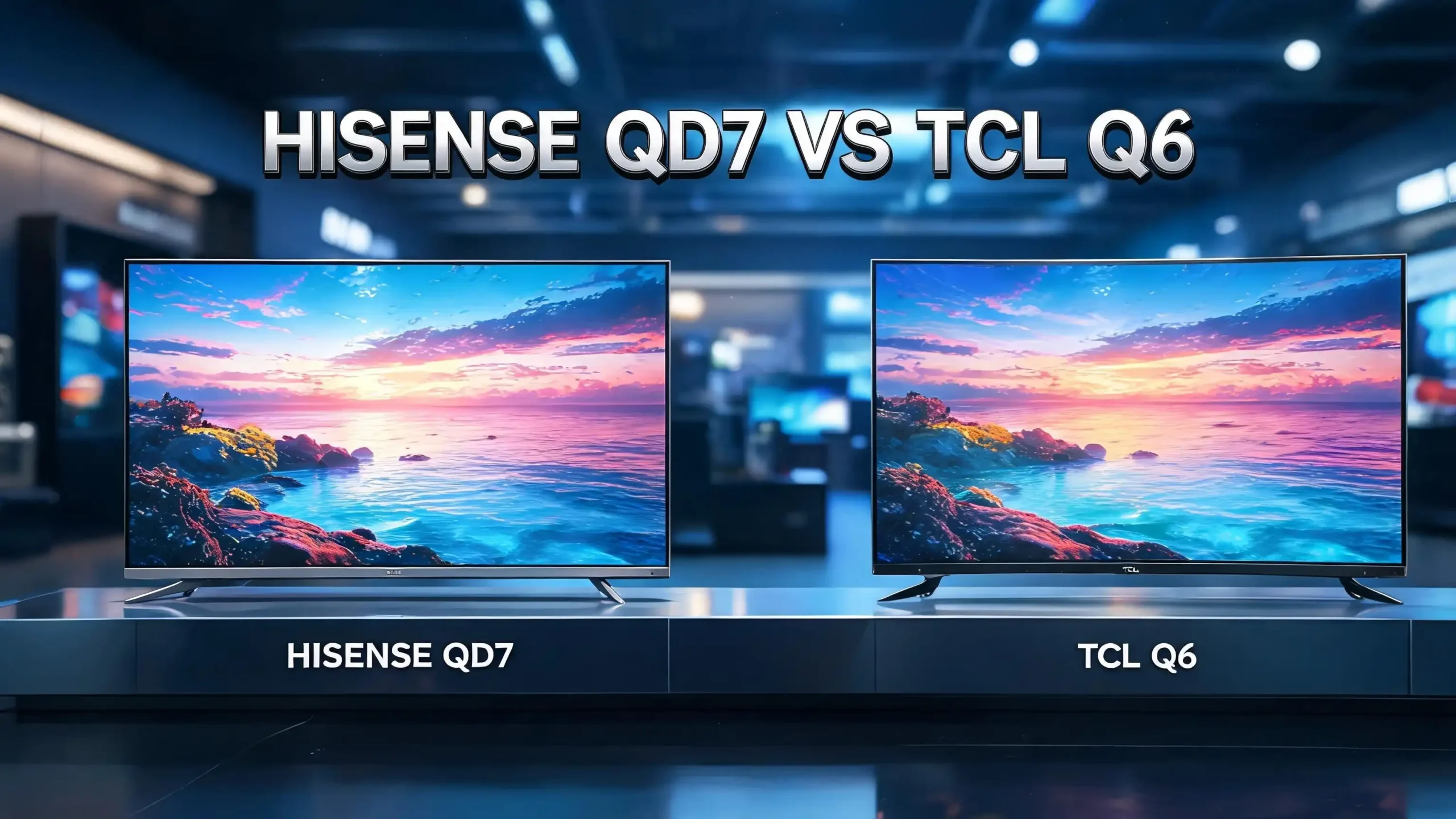
Picking a budget QLED TV feels tricky in 2026. Two names keep showing up in every shopping list: the Hisense QD7 and the TCL Q6. Both promise quantum dot color, smart features, and big screen sizes without draining your wallet.
But which one actually delivers better picture quality, smoother gaming, and stronger value for your money?
This blog post compares both TVs side by side. You will learn about their brightness, HDR support, gaming features, sound quality, and smart platforms. By the end, you will know exactly which TV fits your living room best. Let us jump straight into the details.
In a Nutshell
- The Hisense QD7 uses Mini LED backlighting in its newer 2025 versions, giving it deeper blacks and better contrast control than the TCL Q6.
- The TCL Q6 has a native 144Hz refresh rate on select sizes, which makes it slightly better for fast paced PC gaming.
- The Hisense QD7 offers stronger HDR brightness peaks, hitting around 600 to 1000 nits depending on the model and size.
- The TCL Q6 runs on Google TV, while the Hisense QD7 uses Fire TV or Google TV based on the variant.
- Both TVs support Dolby Vision, HDR10+, and Dolby Atmos, so streaming movies look great on either set.
- The TCL Q6 is usually cheaper, but the Hisense QD7 gives more future proof features for the price difference.
Hisense QD7 Overview

- 4K Ultra High Definition: More pixels on the screen produces a more clear and succinct picture making content look more realistic and true...
- Google TV: The entertainment you love. With a little help from Google. Google TV brings together movies, shows, live TV and more from across...
Last update on 2026-10-12 / Affiliate links / Images from Amazon Product Advertising API
The Hisense QD7 is a 2025 release that targets buyers who want premium features without paying premium prices. It comes in sizes ranging from 50 inches all the way up to 100 inches. The TV uses a QLED panel with quantum dot technology to produce wide color volume.
The QD7 supports Dolby Vision IQ, HDR10+, and Dolby Atmos sound. It includes full array local dimming on most sizes, which improves contrast in dark scenes. The smart platform runs on either Fire TV or Google TV, depending on the regional variant you buy.
Gamers get Game Mode Pro, VRR, ALLM, and a 144Hz refresh rate on larger sizes. The TV also has two HDMI 2.1 ports for next gen consoles. Overall, the QD7 punches above its budget price tag.
Pros:
- Strong HDR brightness peaks
- Full array local dimming for deep blacks
- 144Hz refresh rate on larger models
- Dolby Vision and HDR10+ support
- Wide range of screen sizes available
Cons:
- HDR brightness can feel dim in very bright rooms
- Fire TV interface shows ads on home screen
- Sound quality is average without a soundbar
TCL Q6 Overview

- 4K Ultra HD Resolution: Experience incredible detail with 4X the resolution of 1080p Full HDTVs.
- QLED - Quantum Dot Technology with UltraWide Color Gamut: enjoy over a billion colors for richer and more lifelike images.
Last update on 2026-10-25 / Affiliate links / Images from Amazon Product Advertising API
The TCL Q6 is a value focused QLED TV that has been a bestseller for years. It uses quantum dot color technology paired with direct LED backlighting. The Q6 comes in sizes from 43 inches up to 98 inches, making it flexible for any room.
This TV supports Dolby Vision, HDR10+, HDR10, and HLG formats. It uses TCL’s AiPQ Engine to upscale lower resolution content to 4K. The smart platform is Google TV, which gives access to thousands of apps and Google Assistant voice control.
For gamers, the Q6 includes Auto Game Mode, Game Accelerator 240, and a native 144Hz panel on select sizes. However, it uses basic LED backlighting without local dimming, so contrast is weaker than the Hisense QD7.
Pros:
- Affordable price across all sizes
- Native 144Hz refresh rate on bigger models
- Google TV platform with voice search
- Supports all major HDR formats
- Bezel less design looks modern
Cons:
- No local dimming hurts black levels
- Lower peak brightness in HDR
- Limited HDMI 2.1 port count
- Viewing angles are narrow
Picture Quality Comparison
The Hisense QD7 clearly leads in picture quality. Its full array local dimming creates deeper blacks and brighter highlights at the same time. Dark scenes in movies look richer, with less gray washout in shadows.
The TCL Q6 uses direct LED backlighting without dimming zones. This means blacks often look gray in dim rooms, especially during letterboxed films. However, the Q6 still produces vivid colors thanks to its quantum dot layer.
In SDR content, both TVs handle skin tones and natural scenes well. The QD7 hits around 600 to 1000 nits in HDR peaks, while the Q6 reaches roughly 400 to 500 nits. That gap matters when you watch HDR movies or play HDR games.
If picture quality is your top priority, the Hisense QD7 wins this round. The TCL Q6 is fine for casual viewers, but the QD7 looks noticeably better in side by side tests.
Brightness and HDR Performance
Brightness is where these two TVs differ the most. The Hisense QD7 delivers strong peak brightness, especially on the Mini LED variants. Highlights like sun reflections or fire scenes pop with realism.
The TCL Q6 struggles in bright rooms. Its peak brightness sits around 450 to 500 nits, which is fine for shaded living rooms but weak under direct sunlight. The QD7 handles glare and reflections much better.
Both TVs support Dolby Vision and HDR10+, so streaming services like Netflix and Amazon Prime Video unlock dynamic HDR. The QD7’s higher brightness ceiling makes HDR content feel more impactful and immersive.
If you watch HDR movies often or live in a sunny room, the Hisense QD7 is the safer choice. The TCL Q6 works best in controlled lighting where its limitations stay hidden.
Color Accuracy and Wide Color Gamut
Both TVs use quantum dot technology, so color performance is strong on each model. The Hisense QD7 covers about 95 percent of the DCI P3 color space, which is excellent for the price.
The TCL Q6 covers roughly 90 percent of DCI P3, which is still very good. Reds, greens, and blues look saturated without feeling cartoonish. Skin tones appear natural after a quick calibration.
The QD7 has slightly better factory calibration in Filmmaker Mode and Theater Mode. Color temperature stays closer to the D65 standard, which means whites look pure and not bluish.
For most viewers, both TVs offer enough color accuracy for movies, sports, and gaming. Color critical work like photo editing might still need a higher tier display, but for entertainment, both perform well.
Gaming Features and Refresh Rate
Gamers need to look at refresh rate, input lag, and HDMI 2.1 support. The Hisense QD7 offers a 144Hz native refresh rate on its 55 inch and larger sizes. It has two HDMI 2.1 ports for PS5 and Xbox Series X.
The TCL Q6 also supports 144Hz on select sizes, but it markets this as Game Accelerator 240 through pixel insertion. It includes VRR and ALLM for smooth gameplay without screen tearing.
Input lag on both TVs sits around 10 to 15 milliseconds in Game Mode. That is fast enough for competitive shooters and sports games. The QD7 has slightly better motion handling because of its higher brightness.
If you play console games casually, either TV works fine. For PC gaming with high frame rates, the Hisense QD7 gives a small edge thanks to better contrast and HDR support.
Sound Quality and Audio Features
Both TVs ship with 20 watt stereo speakers that handle dialog and casual viewing well. Neither sounds amazing without a soundbar or external system.
The Hisense QD7 supports Dolby Atmos passthrough and includes some audio enhancement modes. Voices stay clear, but bass response is thin during action scenes.
The TCL Q6 also supports Dolby Atmos and DTS Virtual:X. Its built in speakers sound slightly more open, but they still lack low end punch.
For the best experience, we recommend pairing either TV with a soundbar. A budget Dolby Atmos soundbar transforms the audio and matches the picture quality. Both TVs have eARC support, so connecting external audio is easy.
Smart TV Platform and Apps
The smart platform is a big lifestyle factor. The TCL Q6 runs Google TV, which offers personalized recommendations, Google Assistant voice search, and Chromecast built in. The interface feels clean and fast.
The Hisense QD7 uses Fire TV in the US market. Fire TV gives access to Prime Video, Netflix, Disney Plus, and Alexa voice control. However, Fire TV shows banner ads on the home screen, which some users find annoying.
In other regions, the QD7 sometimes ships with VIDAA OS or Google TV. Both are responsive and support all major streaming apps.
If you prefer a cleaner ad free experience, the TCL Q6 with Google TV might suit you better. If you live inside the Amazon ecosystem, the Hisense QD7 with Fire TV feels natural.
Design and Build Quality
The Hisense QD7 has a sleek design with thin bezels and a sturdy plastic back. The stand uses two metal feet placed near the edges, so you need a wide TV stand to support larger sizes.
The TCL Q6 features a bezel less front that looks modern and premium. Its feet are also wide set, but the build feels slightly lighter than the Hisense.
Both TVs are about 2 to 3 inches thick, which makes them easy to wall mount with a standard VESA bracket. Cable management is basic on both models.
In terms of looks, the TCL Q6 wins on aesthetics, but the Hisense QD7 feels more solid. Either TV looks good in a living room, bedroom, or gaming setup.
Connectivity and Ports
Ports matter when you connect consoles, soundbars, and streaming sticks. The Hisense QD7 offers four HDMI ports, with two supporting HDMI 2.1 at 4K 120Hz. It also has USB ports, optical out, and Ethernet.
The TCL Q6 also includes four HDMI ports, but only one or two support HDMI 2.1 features depending on the size. It has USB, Ethernet, and a headphone jack on some models.
Both TVs support Wi Fi 5 or Wi Fi 6 and Bluetooth 5.0 for wireless headphones and game controllers. Streaming over wireless feels smooth on both.
For a future proof setup, the Hisense QD7 has slight advantages. The extra HDMI 2.1 bandwidth helps with multiple next gen consoles connected at once.
Price and Value for Money
Price is often the deciding factor. The TCL Q6 is usually 50 to 150 dollars cheaper than the Hisense QD7 at the same screen size. That gap can grow during sales events.
The Hisense QD7 justifies its higher price with better contrast, brighter HDR, and more dimming zones. If you watch a lot of movies or play HDR games, the upgrade feels worth it.
The TCL Q6 offers strong value if you want a big screen on a tight budget. A 75 inch Q6 often costs less than a 65 inch QD7. For casual viewers, that size jump matters more than picture refinement.
Both TVs frequently appear in Black Friday, Prime Day, and back to school sales. Watch for discounts before buying.
Which One Should You Buy?
Choose the Hisense QD7 if you want better HDR, brighter highlights, and stronger gaming features. It suits movie lovers, sports fans, and console gamers who care about picture quality.
Choose the TCL Q6 if you want the largest possible screen for the lowest price. It works best for casual viewing, daytime sports, and family rooms with controlled lighting.
Both TVs are solid 2025 and 2026 releases. Neither is a bad pick, but they serve slightly different buyers. Match the TV to your viewing habits, room lighting, and budget.
If you can stretch your budget by 100 to 200 dollars, the Hisense QD7 is the smarter long term investment. If you need a big screen right now without overspending, the TCL Q6 delivers strong basics.
Frequently Asked Questions
Is the Hisense QD7 better than the TCL Q6?
Yes, the Hisense QD7 generally beats the TCL Q6 in picture quality, brightness, and gaming features. It has full array local dimming, higher HDR peaks, and better HDMI 2.1 support. The TCL Q6 wins only on price and screen size value.
Does the TCL Q6 support 4K 120Hz gaming?
Yes, the TCL Q6 supports 4K at 120Hz on select HDMI 2.1 ports. Larger sizes also support a native 144Hz refresh rate. It includes VRR and ALLM for smooth console and PC gaming.
Is the Hisense QD7 a Mini LED TV?
The 2025 Hisense QD7 lineup includes Mini LED variants in larger sizes like 75 inch and 85 inch. Smaller sizes use direct LED with full array local dimming. Check the model number before buying to confirm.
Which TV has better sound, the QD7 or Q6?
Both TVs have similar 20 watt stereo speakers with Dolby Atmos support. The TCL Q6 sounds slightly more open, while the Hisense QD7 has clearer dialog. Neither replaces a dedicated soundbar.
Can I wall mount both TVs?
Yes, both the Hisense QD7 and TCL Q6 support standard VESA wall mounts. The exact VESA size depends on the screen size, ranging from 200×200 mm to 600×400 mm. Always check the manual before buying a mount.
Which TV lasts longer, Hisense or TCL?
Both brands offer similar build quality and one year warranties. User reports suggest both TVs last five to seven years with normal use. Premium models like the QD7 tend to age slightly better due to stronger components.
Does the Hisense QD7 have ads on the home screen?
Yes, the Fire TV version of the Hisense QD7 shows banner ads on the home screen. The Google TV version also shows sponsored content but feels less aggressive. You can limit some tracking in settings.

Hi there! I’m Jinny, the tech enthusiast behind GadgetInsight. I spend my days unboxing the newest devices, diving deep into their features, and figuring out how they can genuinely improve your life – or if they’re worth your hard-earned money at all.