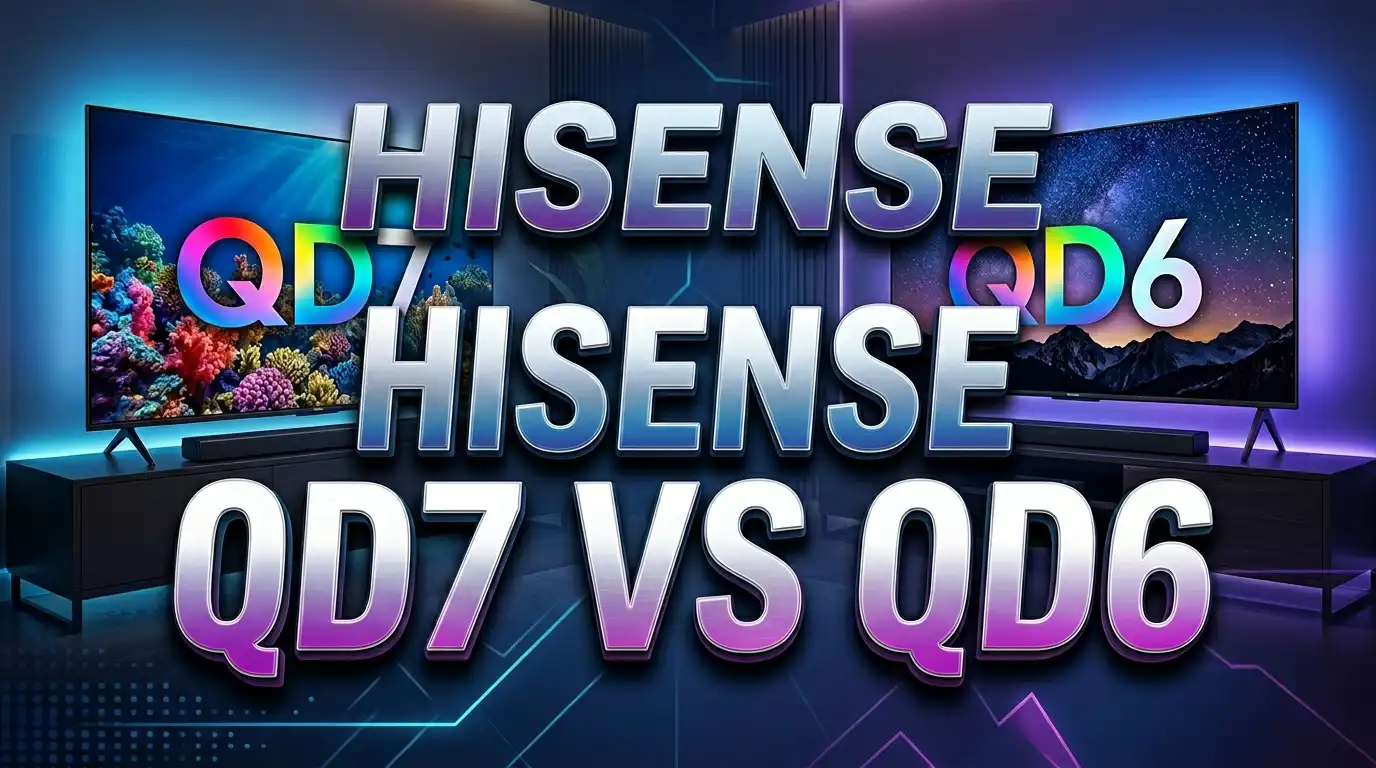
Hisense QD7 vs QD6: Which Is The Best?
Are you stuck choosing between the Hisense QD7 and the Hisense QD6? You are not alone. These two popular QLED TVs from Hisense look similar on paper.
They share the same brand, similar model names, and even run the same smart TV platform. But the differences between them are bigger than you might think.
One uses Mini-LED backlighting with local dimming. The other relies on standard Direct LED. One supports a 144Hz refresh rate with HDMI 2.1. The other caps out at 60Hz with HDMI 2.0. These distinctions affect everything from movie nights to gaming sessions.
By the end of this post, you will know exactly which TV fits your room, your habits, and your budget. Let’s get into it.
Key Takeaways
- The Hisense QD7 uses Mini-LED backlighting with Full Array Local Dimming (FALD). This gives it much better contrast and deeper blacks compared to the QD6. The QD6 uses standard Direct LED backlighting with no local dimming zones. This single difference changes the entire viewing experience.
- The QD7 reaches peak brightness of 600 to 800 nits, while the QD6 tops out around 385 nits. This makes the QD7 significantly better for HDR content and bright room viewing. HDR movies and shows look flat on the QD6 because it simply cannot get bright enough.
- Gamers should strongly consider the QD7. It offers a native 144Hz refresh rate, HDMI 2.1 ports, VRR support, and AMD FreeSync Premium. The QD6 is limited to a 60Hz refresh rate with HDMI 2.0 ports. This matters a lot for PS5 and Xbox Series X owners.
- Both TVs share the same QLED Quantum Dot color technology. Color accuracy and vibrancy are nearly identical between the two models. Both cover about 90% of the DCI-P3 color gamut and display over a billion shades.
- The QD6 costs roughly half the price of the QD7. If your budget is tight and you primarily stream content in a moderately lit room, the QD6 still delivers solid 4K picture quality at an excellent price point.
- Both TVs run Amazon Fire TV with Alexa built in, support Dolby Vision and Dolby Atmos, and offer identical smart TV features. The platform experience is the same across both models.
Hisense QD7 Series: A Mini-LED Powerhouse on a Budget

- MINILED | UP TO 600 NITS PEAK BRIGHTNESS: See more contrast on the field and off. Lots of tiny LEDs make a major difference when it comes to...
- QLED COLOR: See the exact hue of every blade of grass on the field and every line on the court. QLED Color is made up of quantum dots—very...
Last update on 2026-10-25 / Affiliate links / Images from Amazon Product Advertising API
The Hisense QD7 Series sits in the middle of the 2025 Hisense lineup. It packs Mini-LED backlighting into an affordable package. Mini-LEDs are tiny light sources less than 0.2mm in size. Hisense fits hundreds of them behind the screen and groups them into local dimming zones.
Each zone brightens or dims independently. This means a bright explosion on screen does not wash out the dark areas around it. You get deep blacks and punchy highlights at the same time. This is the core advantage of the QD7 over the QD6.
The QD7 also supports a native 144Hz refresh rate. Fast motion looks smooth and clear. Sports, action movies, and video games all benefit from this higher refresh rate. The TV includes HDMI 2.1 ports, VRR, ALLM, and AMD FreeSync Premium for a complete gaming package.
Peak brightness reaches 600 to 800 nits depending on content. This is strong enough for impactful HDR viewing and bright room performance. Dolby Vision, HDR10+, and Dolby Atmos round out the feature set.
Pros:
- Mini-LED with Full Array Local Dimming delivers excellent contrast
- 144Hz native refresh rate is ideal for gaming
- HDMI 2.1 supports PS5 and Xbox Series X at full capability
- Peak brightness of 600 to 800 nits handles HDR and bright rooms well
- Dolby Vision, HDR10+, and Dolby Atmos support
Cons:
- Costs roughly double the QD6 price
- Thicker and heavier than the QD6 due to Mini-LED hardware
- VA panel still has limited viewing angles for large group watching
- Not a true flagship; picture quality falls short of Hisense U8 or U9 models
Hisense QD6 Series: Best Value 4K QLED on the Market

- QLED COLOR: See the exact hue of every blade of grass on the field and every line on the court. QLED Color is made up of quantum dots—very...
- DOLBY VISION AND DOLBY ATMOS: The fusion of Dolby Vision HDR imaging and Dolby Atmos sound transforms your TV into an entertainment...
Last update on 2026-10-25 / Affiliate links / Images from Amazon Product Advertising API
The Hisense QD6 Series is the budget champion in the 2025 Hisense lineup. It uses QLED Quantum Dot technology for vivid, accurate colors. The price is remarkably low for a 65-inch 4K TV with Dolby Vision and Dolby Atmos support.
This TV uses standard Direct LED backlighting without local dimming. All the LEDs behind the screen brighten and dim together. The result is decent picture quality for everyday viewing, but it lacks the contrast and black level performance of the QD7.
Peak brightness sits around 385 nits. This is fine for streaming in a moderately lit room. However, it struggles with HDR content because it cannot get bright enough to make highlights pop. HDR movies may look somewhat flat compared to more capable TVs.
The QD6 runs at a 60Hz native refresh rate with HDMI 2.0 ports. It supports VRR and ALLM for basic gaming features. Casual gamers will find it perfectly adequate. Competitive gamers and PS5 owners will notice the limitations.
Pros:
- Exceptional price for a 65-inch 4K QLED TV
- Quantum Dot color technology delivers vibrant and accurate colors
- Dolby Vision and Dolby Atmos support at a budget price
- Slim and lightweight design makes wall mounting easy
- Fire TV with Alexa offers a smooth smart TV experience
Cons:
- No local dimming results in weaker contrast and washed-out blacks
- 385 nits peak brightness limits HDR performance
- 60Hz refresh rate is not ideal for fast gaming
- HDMI 2.0 ports lack bandwidth for 4K at 120Hz gaming
- Struggles in very bright rooms due to limited brightness output
Display Technology: Mini-LED vs Direct LED Explained
The biggest difference between the QD7 and QD6 is backlighting. This is the technology that lights up the screen from behind. It affects contrast, black levels, brightness, and overall picture quality.
The QD6 uses Direct LED backlighting. Think of it as one big light behind the screen. All the LEDs turn on and off together. There is no zone-based control. A bright object on a dark background forces the entire backlight to increase, which lifts the black levels and reduces contrast.
The QD7 uses Mini-LED backlighting with Full Array Local Dimming. Hundreds of tiny Mini-LEDs sit behind the panel. They are grouped into individual dimming zones. Each zone adjusts its brightness independently. A bright firework on a dark night sky stays bright while the sky around it stays dark.
This zonal control makes a dramatic difference in real-world viewing. Dark scenes in movies look much more realistic on the QD7. Bright highlights have more punch and impact. The QD6 delivers a flatter image in comparison because it cannot separate bright and dark areas effectively.
Brightness and HDR: Why Nits Matter
Brightness is measured in nits. The more nits a TV can produce, the brighter the screen gets. This matters for two big reasons: viewing in bright rooms and displaying HDR content properly.
The QD7 reaches 600 to 800 nits at peak brightness. This is strong enough to overcome sunlight glare from nearby windows. HDR highlights like sunlit clouds, explosions, and reflections look vivid and convincing. The local dimming zones help the QD7 push brightness exactly where it is needed.
The QD6 maxes out around 385 nits. This is adequate for standard content in a room with curtains drawn. But HDR content suffers noticeably. The bright highlights that HDR is supposed to deliver simply do not reach their intended intensity. Movies like Blade Runner 2049 or Mad Max: Fury Road lose much of their visual impact.
Both TVs support Dolby Vision, HDR10+, HDR10, and HLG. The format support is identical. But format support alone does not guarantee a good HDR experience. The TV needs enough brightness and contrast to actually deliver on HDR’s promise. The QD7 does this far better than the QD6.
Color Quality: Quantum Dot Technology Compared
Here is the good news. Color performance is nearly identical on both models. Both the QD7 and QD6 use QLED Quantum Dot technology. Quantum dots are microscopic particles that emit very pure, specific colors when hit by light.
Both TVs cover approximately 90% of the DCI-P3 color gamut. This is the standard used in digital cinema. Both display over a billion color shades. Reds look rich and saturated. Greens appear lush and natural. Blues are deep and true.
Nature documentaries, animated films, and colorful sports broadcasts look equally vibrant on both screens. You will not notice a meaningful color difference in most everyday content. This is one area where the budget QD6 truly holds its own against the pricier QD7.
The QD7 has a slight edge in color volume. Color volume measures how well a TV maintains color accuracy at different brightness levels. Because the QD7 gets brighter, it can display saturated colors at higher luminance levels. But this difference is subtle and most viewers will not notice it during normal viewing.
Gaming Performance: 144Hz vs 60Hz Makes a Big Difference
Gaming is where the gap between these two TVs widens significantly. The QD7 was clearly built with gamers in mind. The QD6 handles casual gaming but falls short for serious players.
The QD7 offers a native 144Hz refresh rate. This means the screen can update 144 times per second. Fast motion in racing games, shooters, and sports titles looks buttery smooth. The TV also includes HDMI 2.1 ports that provide enough bandwidth for 4K gaming at 120 frames per second.
VRR (Variable Refresh Rate) and AMD FreeSync Premium on the QD7 eliminate screen tearing. ALLM (Auto Low Latency Mode) automatically switches to the lowest input lag setting when a game console is detected. These features work together to create a responsive gaming experience.
The QD6 runs at 60Hz with HDMI 2.0. It does support VRR and ALLM, which is nice for a budget TV. But the 60Hz cap means you will never see more than 60 frames per second. PS5 and Xbox Series X owners cannot access the 120fps modes that many modern games now offer.
Smart TV Platform and Software Experience
Both the QD7 and QD6 run Amazon Fire TV as their smart TV operating system. The experience is virtually identical on both models. Fire TV provides a clean interface with easy access to all major streaming apps.
Netflix, Disney+, Prime Video, HBO Max, Apple TV+, Hulu, and hundreds of other apps are available. The home screen features personalized recommendations. Navigation is straightforward with a well-organized menu system.
Amazon Alexa is built into both TVs. You can use voice commands to search for content, control playback, check the weather, and manage smart home devices. Both TVs also support Apple AirPlay for casting content from iPhones, iPads, and Macs.
Some users report that the QD6 shows occasional menu lag during heavy multitasking. The QD7 appears to have a slightly faster processor, resulting in smoother navigation. However, the difference is minor. Both TVs handle the smart TV experience well for everyday use. App loading times and streaming performance are comparable across both models.
Sound Quality: Built-in Speakers Compared
Both the Hisense QD7 and QD6 feature built-in speaker systems with Dolby Atmos decoding. The audio hardware is similar across both models. Neither TV will replace a dedicated soundbar or surround sound system, but both deliver acceptable sound for casual viewing.
The speaker output is 20 watts on both models in the 65-inch size. Dialogue is generally clear and easy to understand. Mid-range frequencies sound balanced. Bass is present but lacks the depth and punch that movie lovers and music fans expect.
Dolby Atmos support means both TVs can process spatial audio from compatible content. However, the two-speaker configuration limits how much spatial effect you actually hear. True Dolby Atmos requires multiple speakers including overhead or upfiring drivers. These TVs simulate the effect rather than delivering it fully.
For the best audio experience with either TV, consider adding a soundbar. A budget soundbar in the $100 to $200 range will transform the audio experience dramatically. Both TVs have HDMI eARC support for easy soundbar connectivity. This is one area where spending a little extra on an accessory makes a big difference regardless of which TV you choose.
Build Quality and Design
The QD6 has an advantage in physical design. It is thinner, lighter, and easier to wall mount. The slim profile makes it a good fit for smaller rooms where a TV should not dominate the space. The bezels are narrow and the overall look is clean and modern.
The QD7 is noticeably thicker and heavier. This is a direct result of the Mini-LED backlighting hardware behind the panel. More LEDs and the local dimming driver boards add bulk. On a TV stand, the difference is not dramatic. On a wall mount, you will notice the QD7 protrudes further.
Both TVs use standard VESA mounting patterns for wall installation. The included table stands are sturdy and stable on both models. Assembly is simple with clear instructions. The remotes are functional with dedicated buttons for popular streaming services and a microphone for Alexa voice commands.
Materials and finish quality feel similar across both models. Hisense uses a combination of plastic and metal in the construction. Neither TV feels cheap or flimsy. Both are well-built for their price points.
Best Room Conditions for Each TV
Your room lighting plays a huge role in which TV performs better for you. The QD7 and QD6 handle different environments in very different ways.
The QD6 works best in a moderately lit room. Close the curtains, keep the overhead lights at a comfortable level, and the QD6 delivers a pleasant viewing experience. Standard streaming content looks good. Colors are vibrant. The picture is sharp and clear.
But put the QD6 in a bright room with large windows, and it struggles. The 385-nit brightness cannot overcome strong ambient light. The image looks washed out and flat. Contrast drops noticeably. This is the QD6’s biggest weakness in real-world use.
The QD7 handles varied lighting conditions much better. Its 600 to 800 nit brightness fights through window glare and overhead lighting. During the day, the picture stays punchy and visible. At night, the local dimming kicks in to deliver deep blacks and excellent contrast for movie watching.
If your TV room has changing light conditions throughout the day, the QD7 is the smarter choice. If you have a dedicated, dimmer viewing space, the QD6 performs well enough to save you the extra money.
Who Should Buy the Hisense QD7?
The QD7 is the right choice for buyers who value picture quality and gaming performance. If you own a PS5, Xbox Series X, or a gaming PC, the 144Hz refresh rate and HDMI 2.1 ports give you access to features the QD6 simply cannot offer.
Movie enthusiasts will appreciate the Mini-LED local dimming. Dark scenes in films look dramatically better on the QD7. Bright highlights pop with real intensity. The overall contrast creates a more cinematic and immersive experience.
The QD7 also suits anyone building a home theater setup. Its contrast performance in dark room conditions approaches what you would expect from much more expensive TVs. Paired with a good soundbar, the QD7 creates a very satisfying movie-watching setup.
If you plan to keep your TV for five or more years, the QD7’s HDMI 2.1 ports and higher refresh rate provide genuine future-proofing. As gaming consoles and streaming content continue to push higher frame rates and better HDR, the QD7 is better equipped to take advantage.
Who Should Buy the Hisense QD6?
The QD6 is perfect for budget-conscious buyers who want solid 4K performance without spending a lot. If you are upgrading from an older 1080p TV, the QD6 will feel like a massive improvement. Colors are vivid, resolution is sharp, and the smart TV experience is smooth.
Casual viewers who primarily stream Netflix, YouTube, and live TV will find the QD6 more than adequate. The Quantum Dot color technology ensures everything looks vibrant. Dolby Vision support adds an extra layer of picture enhancement on supported content.
If gaming is not a priority or you play single-player games casually, the QD6’s 60Hz refresh rate and HDMI 2.0 ports are perfectly fine. Not everyone needs 144Hz or 4K at 120fps. Many popular games run at 60fps, and the QD6 handles this without issue.
The QD6 also makes sense as a second TV for a bedroom, guest room, or kitchen. Its slim design and light weight make placement flexible. The lower price means you can add a quality TV to another room without a major investment.
Final Verdict: Hisense QD7 vs QD6
Both TVs deliver strong value at their respective price points. The Hisense QD6 is an excellent budget QLED that handles everyday 4K viewing with vibrant colors and a polished smart TV platform. It is the best TV you can buy under $400 in the 65-inch category.
The Hisense QD7 is the better TV in almost every measurable way. Mini-LED local dimming, higher brightness, 144Hz gaming, and HDMI 2.1 justify the price increase. For buyers who can stretch their budget, the QD7 delivers a noticeably superior viewing experience that you will appreciate every time you turn it on.
If picture quality and gaming matter to you, choose the QD7. If budget is king and you want reliable 4K performance for streaming and casual use, the QD6 remains an outstanding value.
FAQs
Is the Hisense QD7 worth the extra money over the QD6?
Yes, for most buyers the QD7 is worth the price difference. The Mini-LED backlighting with local dimming provides significantly better contrast and black levels. The 144Hz refresh rate and HDMI 2.1 make it far superior for gaming. If you watch movies in dark rooms or game on a PS5 or Xbox Series X, the QD7 delivers a noticeably better experience. The QD6 is only the better choice if your budget is strictly limited.
Can the Hisense QD6 handle PS5 and Xbox Series X gaming?
The QD6 can connect to PS5 and Xbox Series X through its HDMI 2.0 ports. Games will run at up to 4K at 60fps. However, you will not access 120fps modes or take full advantage of VRR at higher frame rates. The QD6 works for casual console gaming, but serious gamers should invest in the QD7 for the full next-gen experience.
Do both TVs support Dolby Vision and Dolby Atmos?
Yes. Both the Hisense QD7 and QD6 support Dolby Vision, HDR10+, HDR10, HLG, and Dolby Atmos. The format support is identical. The difference is that the QD7 has the brightness and contrast to fully take advantage of these formats, while the QD6’s limited brightness holds back the HDR experience.
Which TV is better for a bright living room?
The Hisense QD7 is much better for bright rooms. Its peak brightness of 600 to 800 nits can fight through window glare and overhead lighting. The QD6 maxes out at 385 nits, which is not enough to maintain good contrast in very bright conditions. If your room gets a lot of natural light, the QD7 is the clear winner.
What smart TV platform do these Hisense TVs use?
Both the QD7 and QD6 run Amazon Fire TV with Alexa built in. You get access to all major streaming apps including Netflix, Disney+, Prime Video, and HBO Max. Both TVs support Apple AirPlay and work with Google Assistant through compatible devices. The smart TV experience is virtually the same on both models.
How big are the Hisense QD7 and QD6 available?
The Hisense QD7 is available in 50-inch, 55-inch, 65-inch, 75-inch, 85-inch, and 100-inch sizes. The Hisense QD6 comes in 43-inch, 50-inch, 55-inch, 65-inch, 75-inch, and 85-inch options. Both series offer a wide range of sizes to fit different room dimensions and viewing distances.

Hi there! I’m Jinny, the tech enthusiast behind GadgetInsight. I spend my days unboxing the newest devices, diving deep into their features, and figuring out how they can genuinely improve your life – or if they’re worth your hard-earned money at all.