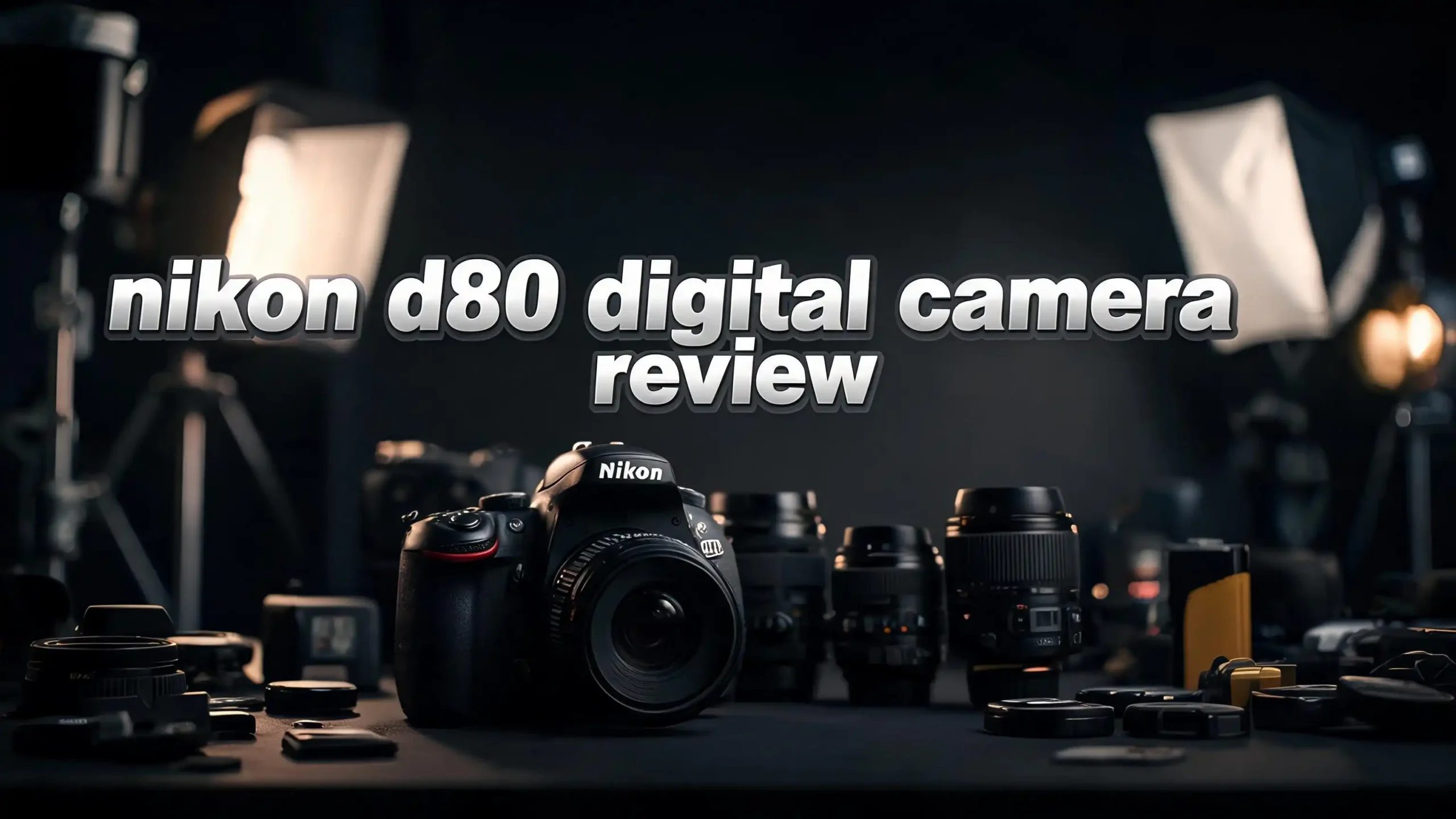
Nikon D80 Digital Camera Review 2026: Still Worth Buying?
The Nikon D80 still surprises photographers in 2026. This classic DSLR launched back in 2006, yet it keeps a loyal fan base today. Many beginners and budget shooters look for a solid camera under $150. The D80 fits that goal with ease.
You might wonder if a 20 year old camera can still deliver sharp images. The short answer is yes. The 10.2 megapixel CCD sensor produces lovely colors and pleasing tones.
This review covers every detail you need before buying. We will look at build quality, image quality, lens support, battery life, and real world use. By the end, you will know if the Nikon D80 is the right pick for your photography journey in 2026.
Key Takeaways
- Strong CCD color science: The 10.2 MP CCD sensor gives warm tones and skin colors that many photographers love over modern CMOS chips.
- Budget friendly: You can find a used D80 body for under $100 in most markets, making it a cheap entry into Nikon DSLR shooting.
- Wide lens support: The Nikon F mount works with thousands of old and new lenses, including cheap manual focus glass.
- Solid build and controls: Twin command dials, a top LCD panel, and a bright pentaprism viewfinder feel premium even in 2026.
- Limited high ISO: The native ISO range stops at 1600, with a boosted 3200 setting that gets noisy fast.
- No video mode: This is a stills only camera, so video creators should look elsewhere.
Nikon D80 Overview and First Impressions

- 10.2-megapixel CCD captures enough detail for large, photo-quality prints
- Body only; lens must be purchased separately
Last update on 2026-10-26 / Affiliate links / Images from Amazon Product Advertising API
The Nikon D80 sits between the entry level D40 and the pro grade D200. Nikon aimed it at serious hobby photographers in 2006. Today it serves as a great learning tool for new shooters.
The body feels solid and balanced in the hand. It uses a polycarbonate shell over a metal frame. The grip is deep and comfortable, even with larger lenses attached. You get a clear top LCD that shows shutter, aperture, and ISO at a glance.
The 2.5 inch rear screen looks small by 2026 standards. Still, it works fine for image review and menu use. The pentaprism viewfinder gives a bright, large view of your scene. This is a key feature that many cheap modern DSLRs skip.
First time users will notice the dual command dials. One sits near the shutter button and one at the rear. This twin dial layout speeds up manual mode shooting a lot.
Image Quality and Sensor Performance
The D80 uses a 10.2 megapixel APSC CCD sensor. This is the same chip family found in the Sony A100 and Pentax K10D from that era. CCD sensors handle color in a special way that many shooters still chase today.
Colors look rich and natural straight out of the camera. Skin tones come out warm and smooth. JPEG files need very little editing for social media or family albums. RAW files give you more room to push and pull tones.
Resolution is enough for sharp 8×10 inch prints and most online use. You can crop into shots without losing too much detail. The anti aliasing filter keeps moire under control in fabrics and patterns.
Dynamic range is the weak point compared to modern sensors. You may lose shadow detail in high contrast scenes. Shoot in RAW and expose for the highlights to get the best results from this sensor.
ISO Range and Low Light Use
The Nikon D80 offers a native ISO range from 100 to 1600. A boosted setting called HI 1 gives you ISO 3200 when you need it. This range felt strong in 2006 but feels limited now.
ISO 100 to 400 looks clean and sharp. Most daytime photos sit in this range with no issues. You can shoot all day at ISO 400 and still get great prints.
ISO 800 starts to show some grain in shadow areas. The noise looks film like rather than ugly digital speckles. Many street and portrait shooters enjoy this look on purpose.
ISO 1600 is usable for web sized images and black and white work. ISO 3200 gets noisy fast and loses fine detail. For dim indoor work, pair the D80 with a fast prime lens like the 50mm f/1.8 to keep ISO low.
Autofocus and Speed
The D80 borrows its autofocus system from the higher end D200. It uses the Multi CAM 1000 module with 11 focus points. This was a big jump from the 5 point system in cheaper Nikon DSLRs of that era.
Focus speed depends a lot on the lens you use. With a fast AF S lens like the 17 55mm f/2.8, focus locks almost instantly. With slower screw drive lenses, you hear the motor work and feel a small lag.
Continuous shooting runs at 3 frames per second. This is enough for kids, pets, and casual sports. Sports pros will want a faster body, but casual users will rarely hit this limit.
The buffer holds about 6 RAW frames before slowing down. Stick to JPEG for longer bursts. The shutter is rated for around 100,000 actuations, which is solid for a midrange camera.
Build Quality and Handling
The D80 weighs about 668 grams without a lens. It feels light enough for all day carry yet sturdy enough for rough use. The body is not weather sealed, so keep it dry in rain.
Buttons sit in logical spots and have a firm, clicky feel. The mode dial offers full PASM modes plus scene presets. The custom function menu is deep and lets you tweak nearly every behavior.
The grip has a rubber coat that holds well in the hand. Long shooting sessions feel less tiring than with smaller entry level DSLRs. Larger hands will love this body more than tiny modern mirrorless cams.
The top LCD panel is a feature you do not find on cheap cameras today. It shows your key settings without turning on the rear screen. This saves battery and keeps you focused on the scene in front of you.
Top 3 Alternatives for Nikon D80

- 24.2MP APS-C Exmor CMOS Sensor and fast BIONZ X processor
- 4K Movie oversampled from 6k w/ full pixel readout, no pixel binning

Last update on 2026-10-26 / Affiliate links / Images from Amazon Product Advertising API

- High image quality featuring a new 24.2 megapixel full-frame CMOS sensor
- DIGIC X Image Processor with an ISO range of 100-102400, expandable to 204800
Last update on 2026-10-26 / Affiliate links / Images from Amazon Product Advertising API

- 16MP Sensor: Captures detailed photos with a CMOS sensor for everyday shooting
- Optical Zoom: 4x optical zoom with a 27mm wide angle lens for flexible framing indoors or outdoors
Last update on 2026-10-26 / Affiliate links / Images from Amazon Product Advertising API
Battery Life and Storage
The D80 uses the EN EL3e lithium ion battery. A fresh battery gives you around 600 shots per charge in normal use. Cold weather and heavy LCD use cut this down a bit.
Replacement batteries are cheap and easy to find online. Many users carry two or three for long trips. The battery slots into a clean compartment with a secure latch.
Storage uses a single SD or SDHC card slot. Cards up to 32GB work well with the D80. Older firmware may have trouble with very large modern cards, so test before a big shoot.
The camera writes files fast enough for most casual work. Pair it with a Class 10 or UHS I card to get the best write speeds. There is no second slot, so back up your photos as soon as you get home.
Lens Compatibility and System
This is where the D80 still shines bright in 2026. The Nikon F mount has been around since 1959. Almost every Nikon lens ever made will mount on this body.
AF S and AF P lenses focus fast and quietly. Older AF D screw drive lenses also autofocus thanks to the built in focus motor. This motor is missing from cheaper bodies like the D3500.
Manual focus AI and AI S lenses mount fine and meter with the D80. You can buy a great old 50mm f/1.4 AI for less than $100. This opens up huge creative options on a small budget.
Third party lenses from Sigma, Tamron, and Tokina also work well. The wide lens support means you can build a full kit for under $300 if you shop smart on the used market.
Menu System and User Interface
Nikon kept the menu layout simple and clear on the D80. New users can find key settings without a manual. The main menu splits into shooting, custom, setup, and retouch tabs.
The custom settings menu has 32 options to tweak. You can change AF area mode, ISO auto behavior, and button roles. This depth is rare in budget DSLRs even today.
The retouch menu lets you crop, fix red eye, and apply filters in camera. This was a fresh idea in 2006 and still works well for quick edits. You can save edited copies without changing the original file.
The info screen on the rear LCD shows all your settings at once. Press the info button to view it any time. Tap the menu button to dive deeper when you need to change something specific.
Video and Live View Limits
Here is the honest truth about the D80 in 2026: it has no video mode. The camera was made before DSLR video became standard. If you want to record clips, this body is not for you.
There is also no live view feature. You must use the optical viewfinder for every shot. This feels strange to new users who learned on phones or mirrorless cameras.
For pure stills shooting, this limit is not a big deal. Many photographers enjoy the focused, distraction free nature of an optical viewfinder. It teaches you to compose with intent.
If video matters to you, look at the Nikon D3500, D5600, or any Z series mirrorless. Those bodies record full HD or 4K with strong autofocus. The D80 stays in its lane as a stills only tool, and it does that job well.
Real World Shooting Experience
Using the D80 in 2026 feels like a small time machine. You slow down and think more about each shot. The lack of a fancy screen pushes you to trust the viewfinder.
Street photography works great with this body. The shutter sound is firm but not too loud. A small prime lens like the 35mm f/1.8 makes a perfect walk around setup.
Portrait work is a strong point too. The CCD sensor renders skin in a soft, warm way that many modern bodies miss. Pair it with the 50mm f/1.8 for classic head and shoulder shots.
Landscape shooters will love the deep color and fine detail at base ISO. Use a tripod and shoot RAW for the best results. The camera holds up well in cool, dry conditions but stay careful in rain or dust.
Price and Value in 2026
You can buy a used Nikon D80 body for $80 to $150 in 2026. Kits with the 18 135mm or 18 55mm lens go for $150 to $250. These prices make the D80 one of the cheapest ways into DSLR photography.
Check the shutter count before you buy any used body. A count under 30,000 means lots of life left. Sellers on eBay and KEH often list this number in the description.
Look for clean glass on any kit lens. Small dust spots inside are normal and rarely affect images. Avoid bodies with sensor scratches or sticky rubber grips.
For the price, the value is very strong if you want a learning tool. New photographers get a real DSLR for less than the cost of a phone case. That kind of value is hard to beat in 2026.
Who Should Buy the Nikon D80 in 2026
The D80 fits a few clear groups of buyers in 2026. Film school students who want to learn manual modes will find it perfect. The dual dials and top LCD teach core camera skills fast.
Hobby photographers on a tight budget will love it too. You get pro level controls without the pro level price tag. Pair it with a cheap 50mm prime and start shooting today.
Vintage gear fans also chase the D80 for its CCD look. The sensor produces a film like quality that some modern shooters edit hard to copy. With the D80 you get that look right out of the camera.
This camera is not for sports pros, video creators, or low light wedding shooters. Those users need newer bodies with better autofocus and high ISO. For everyone else, the D80 still earns a place in the camera bag.
Final Verdict on the Nikon D80
The Nikon D80 in 2026 is a charming, capable, and cheap DSLR. It teaches photography in a way that modern bodies often hide behind menus and screens. The image quality holds up for prints, web use, and personal projects.
Yes, it lacks video, live view, and high ISO power. Those gaps matter for some users. For others, those gaps are part of the appeal.
If you want a serious learning tool for under $150, buy one. If you need modern features, look at the alternatives we shared earlier. Either way, the D80 deserves respect as a classic that still works in 2026.
Frequently Asked Questions
Is the Nikon D80 still worth buying in 2026?
Yes, for budget shooters and learners the D80 is a smart buy. It offers strong image quality, solid build, and wide lens support. The lack of video and live view limits it for some users though.
How many megapixels does the Nikon D80 have?
The Nikon D80 has a 10.2 megapixel APSC CCD sensor. This is enough for sharp prints up to 11×14 inches and all online sharing needs.
Can the Nikon D80 shoot video?
No, the D80 cannot record video. It was made before DSLR video became standard. Look at the Nikon D3500 or Z50 if you need video features.
What lenses work on the Nikon D80?
Almost every Nikon F mount lens works on the D80. AF S, AF P, AF D, and manual focus AI lenses all mount and meter. This includes thousands of cheap used lenses.
What is the best ISO for the Nikon D80?
ISO 100 to 400 gives the cleanest images on the D80. ISO 800 is usable for most scenes. Avoid ISO 1600 and above unless you want a grainy, film like look.
How long does the Nikon D80 battery last?
The EN EL3e battery gives around 600 shots per charge. Cold weather and heavy LCD use will cut this number down. Carry a spare battery for long trips.
Is the Nikon D80 good for beginners?
Yes, the D80 teaches core photography skills very well. Twin command dials, a top LCD, and a clear menu help new users learn fast. The cheap price makes it low risk to try.

Hi there! I’m Jinny, the tech enthusiast behind GadgetInsight. I spend my days unboxing the newest devices, diving deep into their features, and figuring out how they can genuinely improve your life – or if they’re worth your hard-earned money at all.