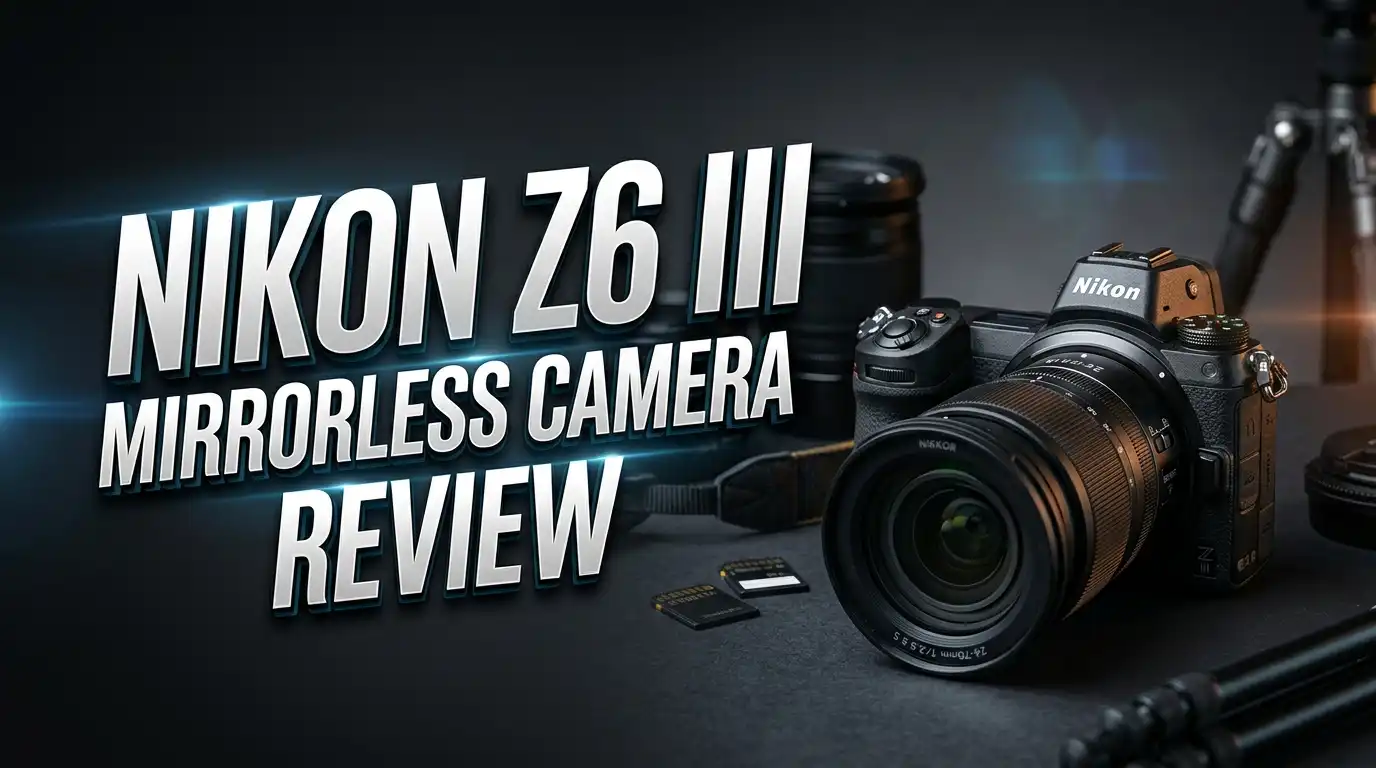
Nikon Z6 III Mirrorless Camera Review 2026: Best Full Frame Camera?
Are you searching for a full frame mirrorless camera that does everything well? The Nikon Z6 III has earned a spot as one of the most talked about cameras since its launch in mid-2024.
It packs a partially stacked CMOS sensor, 6K video recording, AI-powered autofocus, and a stunning electronic viewfinder into a body that costs significantly less than flagship models. But does it still hold up in 2026?
In this detailed Nikon Z6 III mirrorless camera review, we break down every feature, from image quality to battery life. Keep reading to find out why photographers and videographers are still raving about this camera.
Key Takeaways
- The Nikon Z6 III features a 24.5MP partially stacked CMOS sensor that delivers 3.5x faster readout than its predecessor, the Z6 II. This means less rolling shutter, faster burst speeds, and better autofocus performance across the board.
- AI-powered autofocus uses deep learning to detect and track nine subject types, including people, animals, birds, and vehicles. Eye detection AF is fast and reliable for portrait and event photographers.
- Video capabilities are outstanding. The Z6 III records 6K at 60fps in 12-bit N-RAW, 4K at 120fps in DX crop mode, and Full HD at 240fps for slow motion. This makes it a serious hybrid camera for creators.
- The electronic viewfinder is the brightest in its class, with 5.76 million dots and 4,000 nits of brightness. It offers a clear, lifelike view that rivals optical viewfinders.
- Battery life uses the EN-EL15c, and real-world use shows it can last a full day of mixed shooting. The camera also supports USB-C charging and power delivery.
- At an original price of $2,499.95 body only, the Z6 III offers exceptional value compared to flagship cameras like the Nikon Z8 or Z9. Frequent discounts in 2025 and 2026 have brought prices even lower.
Nikon Z6 III Mirrorless Camera Overview

- VIDEO - 6K/60p Internal N-RAW video recording + oversampled 4K UHD, 4K/120p, Full HD/240p slow motion, Hi-Res Zoom up to 2x digital zoom...
- BEST IN CLASS EVF - Max brightness of 4000 nits gives a clear, vibrant view even in very bright conditions; 5760k-dot resolution and premium...

Last update on 2026-10-25 / Affiliate links / Images from Amazon Product Advertising API
The Nikon Z6 III is the third generation of Nikon’s popular mid-range full frame mirrorless line. Nikon announced it on June 17, 2024, and it began shipping on June 24, 2024. It uses the Nikon Z-mount and sits between the entry-level Z5 II and the professional Z8 in Nikon’s lineup.
This camera earned multiple awards, including the TIPA World Award 2025 for Best Full Frame Expert Camera and a Red Dot Award for Product Design 2025. It also won the iF Design Award 2025 and Japan’s Good Design 2024 award. These accolades confirm the Z6 III delivers both form and function.
The body weighs 760 grams with the battery and measures 138 x 101 x 74 mm. It features a fully articulating 3.2-inch touchscreen with 2.1 million dots. You also get dual card slots: one CFexpress Type B/XQD and one SD UHS-II. This gives you flexibility for backup recording or overflow storage.
Sensor and Image Quality
The heart of the Z6 III is its 24.5-megapixel partially stacked BSI CMOS sensor. This is the world’s first partially stacked sensor in a consumer camera. It combines the speed benefits of a fully stacked design with a more affordable price point.
Image quality is excellent. Colors are accurate and natural, with great dynamic range for post-processing. The native ISO range spans 100 to 64,000, and it expands from 50 to 204,800. Low-light performance is strong, with clean images up to ISO 6400 and usable results beyond that.
The faster sensor readout reduces rolling shutter significantly. This matters for action photography, panning shots, and video. If you used the Z6 II before, you will notice a clear improvement in electronic shutter performance.
RAW files offer plenty of latitude for shadow recovery and highlight detail, making this sensor a joy for landscape and event photographers.
Autofocus Performance
The Z6 III uses the EXPEED 7 processor paired with an AI-driven autofocus system borrowed from the flagship Z9 and Z8 cameras. It features 273 focus points in single-point AF and 299 focus points in auto-area AF.
The camera recognizes nine subject types: people, dogs, cats, birds, cars, motorcycles, bicycles, trains, and airplanes. Eye detection AF locks on quickly and holds focus even during fast movement. For portrait and wedding photographers, this is a game-changer.
Low-light autofocus performance is impressive. The Z6 III can focus down to -10 EV, which means it works in near-total darkness.
Firmware 2.0 added an auto-capture feature that lets you set criteria, and the camera takes the shot when those conditions are met. This is useful for wildlife and astrophotography setups.
Video Recording Capabilities
The Z6 III is a powerhouse for video. It records 6K at 60fps in 12-bit N-RAW and ProRes RAW HQ internally. You also get oversampled 4K at up to 60fps, 4K at 120fps in DX crop mode, and Full HD at 240fps for dramatic slow motion.
Professional video features include focus peaking, zebra patterns, and customizable picture profiles. The Flexible Color Picture Control lets you adjust HSL and apply color grading directly in camera. This saves time in post-production.
The camera supports UVC and UAC streaming over USB-C. You can use it as a webcam or live streaming device without additional software. The full-size HDMI 2.1 Type A port allows external recording to devices like the Atomos Ninja. For solo content creators and professional videographers alike, the Z6 III delivers flexibility that few cameras in this price range can match.
Top 3 Alternatives for Nikon Z6 III
Sony Alpha 7 IV offers a 33MP full frame sensor with reliable autofocus and a vast lens ecosystem. It is a proven performer for both stills and video.

- 33MP full-frame Exmor R back-illuminated CMOS sensor.Operating temperature : 0 to 40 °C (32 to 104 °F), Rated input : 100 - 240 V...
- 8x more powerful, next generation BIONZ XR image processing engine
Last update on 2026-10-25 / Affiliate links / Images from Amazon Product Advertising API
Canon EOS R6 Mark III is Canon’s latest hybrid camera with a 32.5MP sensor, 40fps burst shooting, and 7K RAW video recording. It is a direct competitor that pushes performance boundaries.

- 32.5MP full-frame CMOS Image Sensor and DIGIC X Image Processor.
- Up to 40-fps Photo Shooting with 20-frames of pre-continuous shooting.
Last update on 2026-10-25 / Affiliate links / Images from Amazon Product Advertising API
Sony A7C II provides a compact full frame body with 33MP resolution, excellent autofocus, and a lightweight design. It suits travel and street photographers who want full frame quality in a smaller package.

- Incredibly compact and lightweight, packed with full-frame performance
- 33.0MP full-frame Exmor R CMOS sensor
Last update on 2026-10-25 / Affiliate links / Images from Amazon Product Advertising API
Electronic Viewfinder Experience
The Nikon Z6 III has one of the best electronic viewfinders on any mirrorless camera. It features a UXGA resolution of 5.76 million dots and reaches a peak brightness of 4,000 nits. The 0.8x magnification provides a large, immersive view.
This EVF feels close to looking through an optical viewfinder. Colors appear natural, and there is minimal lag even during fast shooting. The high brightness helps in outdoor conditions where other EVFs can look dim or washed out.
Nikon designed this viewfinder for photographers who demand precision. You can see fine details, judge exposure accurately, and track moving subjects with confidence.
If you switch from a DSLR, this EVF will make the transition smoother. Many reviewers have called it the best EVF in this camera class, and after using it, that claim holds true.
In-Body Image Stabilization
The Z6 III includes a five-axis in-body image stabilization (IBIS) system rated at up to 8 stops of compensation. This is a significant upgrade over the Z6 II and matches higher-end Nikon bodies.
What makes this IBIS special is the Focus Point Vibration Reduction technology. First introduced in the Nikon Zf, this system stabilizes the image at the actual focus point rather than the center of the frame. This provides sharper results when your subject is off-center.
For handheld shooting at slow shutter speeds, the IBIS is extremely effective. It benefits landscape photographers shooting at dusk, videographers walking with the camera, and anyone who leaves their tripod at home. Combined with optically stabilized lenses, the system becomes even more powerful.
Build Quality and Ergonomics
The Z6 III has a professional-grade build with weather sealing throughout the body. It handles rain, dust, and cold temperatures with confidence. The magnesium alloy construction feels solid without being too heavy.
Ergonomics are excellent. The deep grip provides a secure hold, even with larger telephoto lenses. Button placement is intuitive, with dedicated controls for ISO, exposure compensation, and recording. The top LCD panel shows key settings at a glance.
The fully articulating touchscreen flips out for vlogging and overhead shots. It also folds flat against the body for protection during transport.
The menu system is well-organized and responds quickly to touch input. Nikon has clearly listened to user feedback and refined the handling experience in this generation.
Connectivity and Smart Features
The Z6 III offers Wi-Fi (802.11ac), Bluetooth Low Energy, USB-C, and full-size HDMI 2.1. These connections cover every modern workflow need.
USB-C supports both charging and data transfer. You can charge the battery while shooting, which is helpful for long sessions or time-lapse work. Bluetooth maintains a low-power connection to your smartphone for GPS tagging and remote shooting.
Nikon’s Imaging Cloud integration lets you transfer images wirelessly for storage and sharing. The SnapBridge app connects your phone for remote control and image transfer. Firmware 2.0 also added C2PA image authentication for content credibility.
This embeds verifiable metadata into your photos, which is important for journalists and stock photographers. The connectivity package is comprehensive and future-proof.
Battery Life and Power Management
The Z6 III uses the EN-EL15c rechargeable lithium-ion battery. The official CIPA rating is 380 shots per charge, but real-world performance often exceeds this. Many photographers report getting 500 to 800 shots in a typical day of mixed shooting.
USB Power Delivery means you can run the camera from a power bank. This is a great option for extended video shoots or all-day events. The camera is also backward compatible with older EN-EL15a and EN-EL15b batteries if you already own them.
For professionals who need more power, the optional MB-N14 battery grip doubles battery capacity. It also improves ergonomics for vertical shooting. Battery management is smart and efficient, with the camera conserving power during idle periods without slowing down wake-up times.
Lens Compatibility and Z-Mount Ecosystem
The Nikon Z-mount ecosystem has grown significantly since its launch. The Z6 III can use all native Z-mount lenses, and Nikon’s lineup now includes fast primes, versatile zooms, and specialty glass.
Popular choices include the Nikkor Z 24-70mm f/2.8 S, Nikkor Z 70-200mm f/2.8 VR S, and Nikkor Z 50mm f/1.2 S. In 2026, Nikon released the Z 24-105mm f/4-7.1 as a lightweight everyday zoom. Third-party support from Tamron, Sigma, and Viltrox also continues to expand.
The FTZ II mount adapter lets you use older Nikon F-mount lenses with varying degrees of compatibility. If you are upgrading from a Nikon DSLR, your existing glass likely still works. The Z-mount system offers a bright future with excellent optical quality across the range.
Nikon Z6 III vs Nikon Z6 II: What Changed?
The Z6 III represents a major generational leap over the Z6 II. The partially stacked sensor provides 3.5x faster readout speeds. The EXPEED 7 processor replaces the dual EXPEED 6 setup.
Autofocus is dramatically improved. The Z6 III uses AI-based subject detection inherited from the Z9, while the Z6 II used an older, less capable system. Burst shooting jumps from 14fps to 20fps with full RAW output and up to 120fps in cropped mode.
Video gets a huge boost. The Z6 II topped out at 4K 60fps. The Z6 III delivers 6K 60fps, 4K 120fps, and 1080p 240fps. The EVF is brighter and sharper, IBIS gains 2 extra stops, and the body adds a full-size HDMI port. If you own a Z6 II, the upgrade is absolutely worth it.
Who Should Buy the Nikon Z6 III?
The Z6 III suits a wide range of photographers and videographers. Wedding and event photographers will love the reliable autofocus, fast burst speed, and excellent low-light performance. Portrait photographers benefit from eye detection AF and beautiful color science.
Wildlife and sports shooters get 20fps bursts with tracking and the auto-capture feature. Landscape photographers appreciate the dynamic range, IBIS, and weather sealing. Videographers gain access to 6K RAW recording and professional-grade tools.
If you want one camera body that does everything well, the Z6 III delivers. It is not the cheapest option, and it does not have the highest resolution. But it balances speed, quality, video, and handling better than almost any camera in its class. This is the camera you buy when you want to stop compromising.
Pricing and Value in 2026
- VIDEO - 6K/60p Internal N-RAW video recording + oversampled 4K UHD, 4K/120p, Full HD/240p slow motion, Hi-Res Zoom up to 2x digital zoom...
- BEST IN CLASS EVF - Max brightness of 4000 nits gives a clear, vibrant view even in very bright conditions; 5760k-dot resolution and premium...
Last update on 2026-10-25 / Affiliate links / Images from Amazon Product Advertising API
The Nikon Z6 III launched at $2,499.95 for the body only. Throughout 2025 and into 2026, prices have dropped through sales and promotions. Some retailers have offered it for under $2,100, making it an even better deal.
The kit with the Nikkor Z 24-70mm f/4 S lens provides a complete starting package. For the performance you get, the Z6 III offers exceptional value compared to cameras like the Canon R6 Mark III or Sony A7 IV at similar or higher price points.
Used and refurbished units are also appearing on the market, which makes this camera accessible to a broader audience. Whether you buy new or used, the Z6 III is one of the best investments in full frame mirrorless photography right now.
Pros and Cons of the Nikon Z6 III
Pros:
- Fast partially stacked sensor with minimal rolling shutter
- AI-powered autofocus with nine subject types
- Outstanding 6K/4K/1080p video capabilities
- Brightest EVF in its class at 4,000 nits
- 8-stop IBIS with Focus Point VR
- Dual card slots (CFexpress + SD)
- Full-size HDMI 2.1 port
- Strong weather sealing and ergonomics
Cons:
- 24.5MP resolution may feel limiting for heavy croppers
- CIPA battery rating of 380 shots is modest on paper
- No built-in flash
- CFexpress Type B cards are still expensive
- 4K 120fps requires DX crop
Final Verdict: Is the Nikon Z6 III Worth It in 2026?
Yes. The Nikon Z6 III remains one of the best all-around mirrorless cameras you can buy in 2026. It offers flagship-level autofocus, impressive video specs, a stunning viewfinder, and solid build quality at a price well below the professional tier.
It is not perfect. The 24.5MP count is adequate but not class-leading. Battery life could be better on paper. And CFexpress cards add to the total cost. But these are minor trade-offs for a camera that excels at virtually everything else.
If you shoot a mix of stills and video, the Z6 III handles both with confidence. If you need reliability and speed, it delivers. If you want a camera that will serve you well for years, the Nikon Z6 III is a smart choice. It earned its awards, and it earns our recommendation.
Frequently Asked Questions
Is the Nikon Z6 III good for beginners?
The Z6 III is a professional-grade camera, but its intuitive controls and guided menu system make it accessible. Beginners who plan to grow into photography will appreciate its advanced features over time. It is a long-term investment that will not limit your creative development.
Does the Nikon Z6 III have dual card slots?
Yes. The Z6 III has one CFexpress Type B/XQD slot and one SD UHS-II slot. You can use them for overflow, backup, or separate RAW and JPEG storage. This dual-slot setup is essential for professional work where data safety matters.
Can I use older Nikon lenses on the Z6 III?
Yes. With the Nikon FTZ II adapter, you can mount most Nikon F-mount lenses on the Z6 III. AF-S and AF-P lenses retain full autofocus. Older AF and AI lenses work with manual focus and may support metering depending on the specific lens.
How does the Nikon Z6 III compare to the Sony A7 IV?
The Nikon Z6 III offers faster burst speeds, better video specs, less rolling shutter, and a superior EVF. The Sony A7 IV provides higher resolution at 33MP and a more mature lens ecosystem. Both are excellent cameras, and the choice depends on your priorities and existing gear.
Is the Nikon Z6 III weather sealed?
Yes. The Z6 III features comprehensive weather sealing on the body, including around buttons, dials, and card slot covers. It handles rain and dust with confidence. Pair it with a weather-sealed Z-mount lens for full protection in harsh conditions.
What is the best memory card for the Nikon Z6 III?
For maximum performance, use a CFexpress Type B card in the primary slot. This is essential for 6K video recording and high-speed bursts. For the secondary slot, a fast SD UHS-II card works well for backup or overflow shooting.

Hi there! I’m Jinny, the tech enthusiast behind GadgetInsight. I spend my days unboxing the newest devices, diving deep into their features, and figuring out how they can genuinely improve your life – or if they’re worth your hard-earned money at all.