Sony ZV-1F Vlogging Camera Review 2026: Best Budget Vlog Cam?
Are you a content creator looking for a compact, affordable vlogging camera that delivers great video quality without breaking the bank? The Sony ZV-1F has been a fan favorite since its release, and it continues to hold its ground in 2026.
But is it still worth buying in 2026? With newer options from Canon, DJI, and even Sony’s own lineup flooding the market, you need a clear answer. That is exactly what this review delivers.
Whether you are a beginner or an experienced creator on a budget, this review will help you decide if the ZV-1F is the right camera for your needs. Keep reading to find out everything you need to know.
Key Takeaways
- The Sony ZV-1F features a large 1-inch Exmor RS CMOS sensor with 20.1 megapixels, which is impressive for a camera at this price point. It produces sharp stills and detailed 4K video even in moderate low-light conditions.
- The fixed 20mm ultra-wide lens with an F2.0 aperture is a major highlight. It captures wide scenes at arm’s length, making it perfect for selfie-style vlogging without needing an external lens or accessory.
- 4K video recording at 30fps and 1080p at 120fps gives you solid creative options. You can shoot cinematic slow-motion clips in Full HD and sharp standard footage in 4K for YouTube or TikTok.
- The built-in 3-capsule microphone with a windscreen sets this camera apart from many competitors. Audio quality is surprisingly good for a compact camera, and the included wind screen reduces outdoor noise effectively.
- Battery life sits at approximately 360 shots or 75 minutes of continuous video recording. This is adequate for short vlogging sessions but may require a spare NP-BX1 battery for longer shoots.
- Priced around $498, the ZV-1F remains one of the most affordable compact vlogging cameras with a 1-inch sensor in 2026, making it a strong value pick for beginner creators.
Sony ZV-1F Vlogging Camera Overview

- Ultra-wide 20mm lens gets it all in the frame, even at arm’s length
- Large 1” sensor and F2 lens, for low-light and defocusing backgrounds

Last update on 2026-09-03 / Affiliate links / Images from Amazon Product Advertising API
The Sony ZV-1F is a compact vlogging camera built for content creators and social media enthusiasts. Sony released it as a more affordable alternative to the original ZV-1. It strips away the zoom lens and replaces it with a fixed 20mm wide-angle prime lens. This design choice keeps the price lower and the body lighter.
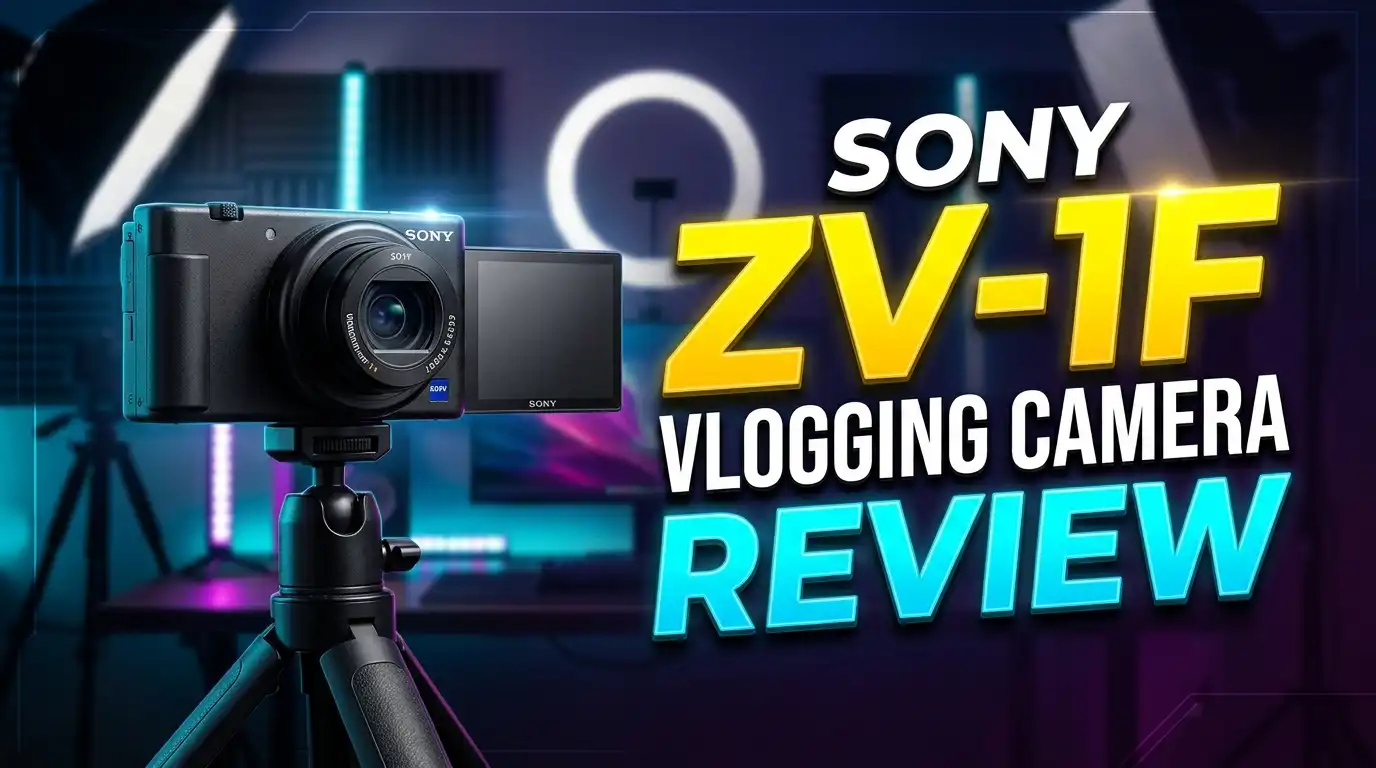
The camera measures just 106 x 60 x 46 mm and weighs only 256 grams with the battery and memory card installed. You can slip it into a jacket pocket or a small bag with ease. The build quality feels solid for its size, with a comfortable grip on the front.
Sony designed the ZV-1F with simplicity in mind. It runs on the BIONZ X image processor and offers features like Background Defocus, Product Showcase, and Soft Skin Effect at the press of a button. These one-touch features make it easy for beginners to get professional-looking results without diving into manual settings.
Design and Build Quality
The Sony ZV-1F has a clean, minimal design that feels modern and creator-friendly. The body is lightweight plastic, but it does not feel cheap. Sony kept the button layout simple with easy access to the record button, mode dial, and custom controls.
The front features a small but effective grip that helps with one-handed shooting. On the top, you will find the three-capsule directional microphone and a slot for the included wind screen. The wind screen attaches magnetically, which is a nice touch for quick outdoor transitions.
On the rear, there is a 3-inch vari-angle LCD touchscreen that flips out and rotates 180 degrees. This is essential for selfie-style vlogging. The screen is bright enough for outdoor use, though it can struggle under direct sunlight.
Connectivity options include USB-C, Micro HDMI, and a 3.5mm microphone jack for external audio. There is also a Multi Interface Shoe on top for accessories like Sony’s wireless microphones.
Lens Performance: 20mm Ultra-Wide Fixed Lens
The ZEISS Tessar T 20mm F2.0 lens* is one of the defining features of the ZV-1F. The ultra-wide focal length captures a large field of view. This makes it ideal for vlogging at arm’s length because you and your background fit easily into the frame.
The F2.0 maximum aperture allows good light gathering in dim environments. It also creates a pleasant background blur effect, especially with Sony’s Background Defocus mode. The bokeh is smooth and natural, giving your videos a more cinematic feel.
However, the fixed focal length means there is no optical zoom. You cannot zoom in on distant subjects without cropping into the image digitally. This is a trade-off for the smaller body and lower price. If you need zoom, Sony’s ZV-1 II would be a better pick.
Sharpness is strong across the frame at most aperture settings. Edge distortion is minimal thanks to Sony’s in-camera correction. The lens handles flare reasonably well, though you may notice some softness in extreme backlit conditions.
Top 3 Alternatives for Sony ZV-1F
1. Canon PowerShot V10

- Compact Powerhouse: Canon PowerShot V10 vlogging camera features a sleek, pocket-sized design; perfect for on-the-go creativity; enjoy the...
- Versatile Vlogging Camera: Incredible low-light capabilities with a 15.2-megapixel 1-inch back-illuminated CMOS sensor; features a...
Last update on 2026-10-25 / Affiliate links / Images from Amazon Product Advertising API
The Canon PowerShot V10 is an ultra-compact vlogging camera with a built-in kickstand and stereo microphones. It features a 1-inch sensor and a 19mm wide-angle lens. It is even smaller than the ZV-1F and is perfect for quick, casual content. Canon’s color science also gives skin tones a warm, natural look.
2. DJI Osmo Pocket 3

- Capture Stunning Footage - Osmo Pocket 3 vlogging camera features a 1-inch CMOS sensor and records in 4K resolution at an impressive 120fps...
- Effortlessly Frame Your Shots - Get the ideal composition with Osmo Pocket 3's expansive 2-inch touch screen that rotates for both...
Last update on 2026-10-25 / Affiliate links / Images from Amazon Product Advertising API
The DJI Osmo Pocket 3 is a gimbal-stabilized pocket camera with a 1-inch CMOS sensor and 4K/120fps recording. If smooth, stabilized video is your top priority, this device is hard to beat. It features a rotating touchscreen and excellent face tracking. It is a great alternative if you shoot a lot of walking or travel content.
3. Sony ZV-E10 II

- Exmor R CMOS sensor: The ZV-E10 II features Sony's most advanced sensor technology in an APS-C back-illuminated Exmor R CMOS image sensor...
- Interchangeable lenses to capture your vision : From the G Master series, which blends breathtaking resolution with exquisite bokeh, to the...
Last update on 2026-10-25 / Affiliate links / Images from Amazon Product Advertising API
The Sony ZV-E10 II is an interchangeable lens mirrorless camera with a larger APS-C sensor and 26 megapixels. It costs more than the ZV-1F, but it offers significantly better image quality, lens flexibility, and 4K/120fps video. It is the ideal step up if you want more creative control and room to grow.
4K Video Quality and Performance
The Sony ZV-1F records 4K video at 3840 x 2160 resolution at 30 frames per second. The footage looks sharp and detailed with accurate colors. Sony’s color rendering produces natural skin tones, which is important for face-to-camera vlogging.
In Full HD (1080p), you can shoot at up to 120fps for smooth slow-motion clips. This is great for creative B-roll, transitions, or dramatic effect in your edits. The slow-motion footage maintains good detail and exposure.
The camera uses the XAVC S codec for efficient compression. File sizes are manageable even for 4K clips. You can record to a standard microSD card without worrying about massive storage requirements.
One limitation is the lack of 4K at 60fps. Many competing cameras now offer this, and its absence is noticeable in 2026. If you need smoother 4K footage, you will need to look at pricier options like the ZV-E10 II or the DJI Osmo Pocket 3.
Autofocus System: Fast but Not Flawless
Sony equipped the ZV-1F with a contrast-detection autofocus system featuring 315 points. It covers most of the frame and locks onto subjects quickly. Real-time Eye AF and face detection work well for selfie-style shooting, keeping your face sharp as you move.
The Product Showcase mode is a standout feature. It shifts focus quickly from your face to an object held in front of the camera. This is useful for unboxing videos, product reviews, or cooking vlogs. The transition is smooth and intuitive.
However, some reviewers have noted occasional autofocus flutter in low-contrast or challenging light scenes. The contrast-detection system can hunt briefly before locking on. This is less reliable than the phase-detection AF found in Sony’s mirrorless cameras.
For most standard vlogging scenarios, the autofocus is fast and accurate enough. But if you shoot in dimly lit environments often, keep in mind that performance may dip slightly.
Audio Quality: Built-In Microphone Review
Audio is a critical part of any vlog, and the Sony ZV-1F delivers surprisingly good sound from its built-in microphone. The 3-capsule directional microphone captures clear voice audio from the front of the camera. It does a decent job of reducing background noise.
The included magnetic wind screen is a practical accessory for outdoor shooting. It snaps onto the top of the camera and reduces wind noise significantly. This small addition saves you from needing an external mic for casual outdoor content.
You also get a 3.5mm external microphone jack, which allows you to connect a dedicated mic for higher quality audio. This is a feature that many compact cameras at this price skip. It gives you a clear upgrade path if you want professional-level sound.
The camera supports intelligent wind noise reduction in its settings. Combined with the wind screen, outdoor audio performance is above average for a camera in this class. For indoor recording, the built-in mic is more than sufficient for YouTube and social media content.
Image Stabilization: How Steady Is It?
The Sony ZV-1F uses electronic image stabilization (EIS) rather than optical stabilization. Sony calls it Active Mode, and it works by cropping into the sensor to stabilize handheld footage. The result is reasonably smooth video for stationary or slow-moving shots.
Walking while vlogging tells a different story. The electronic stabilization reduces shake but does not eliminate it completely. You will still see some wobble and micro-jitter during fast movements. It does not match the smoothness of a gimbal or the OIS found in some competing cameras.
For seated or stationary vlogging, the stabilization is perfectly adequate. Handheld shots look clean and stable. If you plan to walk and talk frequently, you may want to pair the ZV-1F with a small gimbal or consider the DJI Osmo Pocket 3.
The stabilization crop is also worth noting. When Active Mode is enabled, the field of view gets slightly narrower. This is a small trade-off, but the 20mm wide-angle lens compensates for most of the crop.
Battery Life and Charging
The Sony ZV-1F uses the NP-BX1 rechargeable battery, a common Sony battery found across many of their compact cameras. Sony rates the battery at approximately 360 shots for stills and around 75 minutes of continuous video recording.
In real-world use, you can expect roughly 60 to 70 minutes of video before needing a recharge. This is enough for a few short vlogging sessions but falls short for longer shoots. Carrying a spare NP-BX1 battery is strongly recommended.
The camera charges via USB-C, which is convenient. You can top it up using a portable power bank between takes. Sony also allows you to power the camera while recording through USB-C, which is a useful workaround for extended shoots like live streams or long sit-down videos.
The battery charges fully in about two hours via USB-C. It is not the fastest charging experience, but the small battery size means it does not take too long. The NP-BX1 batteries are affordable and widely available online.
Flip Screen and Touchscreen Features
The 3-inch vari-angle LCD touchscreen is a key feature for vloggers. It flips out to the side and rotates a full 180 degrees. This gives you a clear view of yourself while recording from the front. The hinge feels sturdy and reliable.
The touchscreen supports tap-to-focus, which lets you shift focus to any point on the screen during recording. This is faster and more intuitive than using buttons. You can also navigate menus and adjust settings using touch input.
Screen resolution sits at 921,600 dots, which is standard for this class. The image on screen is detailed enough for accurate framing and focus checks. Colors on the LCD represent the actual output fairly well.
One downside is the lack of a viewfinder. In bright sunlight, the LCD can become hard to see even at full brightness. A screen shade or shooting in shaded areas can help. For most indoor or overcast conditions, the screen performs well.
Connectivity: Wi-Fi, Bluetooth, and Streaming
The ZV-1F offers Wi-Fi and Bluetooth connectivity for transferring files and remote control. You can pair it with the Sony Imaging Edge Mobile app on your smartphone. The app lets you transfer photos and videos wirelessly and use your phone as a remote shutter.
A standout feature is USB live streaming support. You can connect the ZV-1F to a computer via USB-C and use it as a high-quality webcam. This makes it a dual-purpose device for both vlogging on the go and live streaming at your desk.
The camera also supports Bluetooth remote control through compatible Sony accessories. This is handy for group photos, time-lapse setups, or any situation where you need to trigger the shutter remotely.
File transfer via Wi-Fi is functional but not the fastest. Large 4K video files take time to move wirelessly. For quicker transfers, removing the microSD card and using a card reader is the better option. Still, the wireless option is convenient for sharing quick clips to social media.
Who Should Buy the Sony ZV-1F?
The Sony ZV-1F is ideal for beginner vloggers and content creators who want a dedicated camera that is better than a smartphone. If you shoot YouTube videos, TikTok content, Instagram Reels, or casual travel vlogs, this camera delivers solid results at a reasonable price.
It is also a good pick for students, hobbyists, and small business owners who need a simple, affordable video tool. The one-touch features and automatic modes make it easy to pick up and start shooting immediately. You do not need technical camera knowledge to get good footage.
However, the ZV-1F is not the best choice for professional videographers or photographers who need zoom, advanced autofocus, or raw photo capabilities. It is also not ideal for action or sports content due to its limited stabilization and contrast-based AF.
If you want a camera that fits in your pocket, produces great video, and records clear audio right out of the box, the ZV-1F remains a smart buy in 2026. It does a few things very well and keeps the experience simple.
Sony ZV-1F vs. Smartphone: Do You Still Need This Camera?
Modern smartphones shoot impressive 4K video. So why would you buy the ZV-1F? The answer comes down to sensor size, audio, and dedicated controls.
The ZV-1F has a 1-inch sensor, which is significantly larger than most smartphone sensors. This gives it an advantage in low-light performance and background blur. Skin tones and color accuracy also tend to look more natural from a dedicated camera.
The built-in directional microphone is another major advantage. Smartphones pick up sound from all directions, which captures unwanted background noise. The ZV-1F focuses audio pickup from the front, resulting in clearer voice quality.
Physical controls like the dedicated record button, mode dial, and shoe mount give the ZV-1F a faster, more flexible workflow. You do not need to open apps, navigate menus, or deal with notification interruptions. The camera is always ready to record.
That said, smartphones are catching up quickly. If you already own a flagship phone with a good camera, the ZV-1F may offer only a marginal upgrade for casual use. But for anyone serious about consistent content quality, a dedicated camera still has clear benefits.
Pros and Cons of the Sony ZV-1F
- Ultra-wide 20mm lens gets it all in the frame, even at arm’s length
- Large 1” sensor and F2 lens, for low-light and defocusing backgrounds
Last update on 2026-09-03 / Affiliate links / Images from Amazon Product Advertising API
Every camera has strengths and weaknesses. Here is an honest look at where the Sony ZV-1F excels and where it falls short in 2026.
On the positive side, the ultra-wide 20mm lens is perfect for vlogging. The 1-inch sensor produces excellent video quality. The built-in microphone with wind screen is better than most compact cameras. The camera is lightweight, portable, and easy to use. The price remains competitive at around $498.
On the downside, the lack of optical zoom limits versatility. The contrast-detection autofocus can flutter in tricky lighting. Battery life is modest at around 75 minutes of video. There is no 4K at 60fps. The electronic stabilization is average for walking shots.
Overall, the pros outweigh the cons for its target audience. If your primary use is face-to-camera vlogging and social media content, the limitations are easy to work around. The strengths directly serve the vlogging workflow.
Final Verdict: Is the Sony ZV-1F Worth It in 2026?
The Sony ZV-1F remains a relevant and competitive vlogging camera in 2026. It offers a strong combination of video quality, audio performance, and portability at a price that undercuts many alternatives. Sony built it with a clear purpose, and it fulfills that purpose well.
Yes, there are newer cameras with better specs. The Canon PowerShot V1, DJI Osmo Pocket 3, and Sony ZV-E10 II all offer upgrades in certain areas. But they also cost more or serve slightly different use cases.
For a beginner or budget-conscious creator, the ZV-1F hits the sweet spot. It gives you a noticeable upgrade over smartphone video, a great built-in microphone, and a simple shooting experience. It is the kind of camera you can grab, press record, and trust to deliver good content.
If you need zoom, advanced stabilization, or interchangeable lenses, look elsewhere. But if you want a reliable, affordable, pocket-friendly vlogging camera, the Sony ZV-1F is still one of the best options you can buy.
Frequently Asked Questions
Is the Sony ZV-1F good for YouTube videos?
Yes, the Sony ZV-1F is an excellent choice for YouTube videos. It records 4K video at 30fps with sharp detail and natural colors. The built-in microphone captures clear audio, and the flip screen makes it easy to frame yourself while recording. Many YouTubers still use the ZV-1F as their primary vlogging camera in 2026.
Does the Sony ZV-1F have image stabilization?
The ZV-1F uses electronic image stabilization (Active Mode) rather than optical stabilization. It works well for stationary and slow-moving shots. However, it may not fully eliminate shake during walking or fast movements. Pairing it with a small gimbal can improve stability for on-the-go vlogging.
Can I use the Sony ZV-1F as a webcam?
Yes, the Sony ZV-1F supports USB live streaming. You can connect it to your computer via USB-C and use it as a webcam for Zoom, OBS, or other streaming software. The 1-inch sensor and quality lens make it a significant upgrade over built-in laptop webcams.
What memory card does the Sony ZV-1F use?
The Sony ZV-1F uses microSD, microSDHC, or microSDXC memory cards. For 4K video recording, Sony recommends a card with a minimum write speed of UHS Speed Class 3 (U3). A 64GB or 128GB card is a good starting point for most vloggers.
How long can the Sony ZV-1F record video continuously?
The Sony ZV-1F can record approximately 75 minutes of continuous video on a full charge. However, actual recording time varies based on resolution, frame rate, and environmental conditions. You can extend recording time by powering the camera through USB-C while shooting.
Is the Sony ZV-1F still worth buying in 2026?
The ZV-1F is still worth buying in 2026, especially for beginner vloggers on a budget. At around $498, it offers a 1-inch sensor, 4K recording, excellent audio, and a compact design. While newer cameras offer upgraded specs, the ZV-1F provides great value for its price and purpose.

Hi there! I’m Jinny, the tech enthusiast behind GadgetInsight. I spend my days unboxing the newest devices, diving deep into their features, and figuring out how they can genuinely improve your life – or if they’re worth your hard-earned money at all.