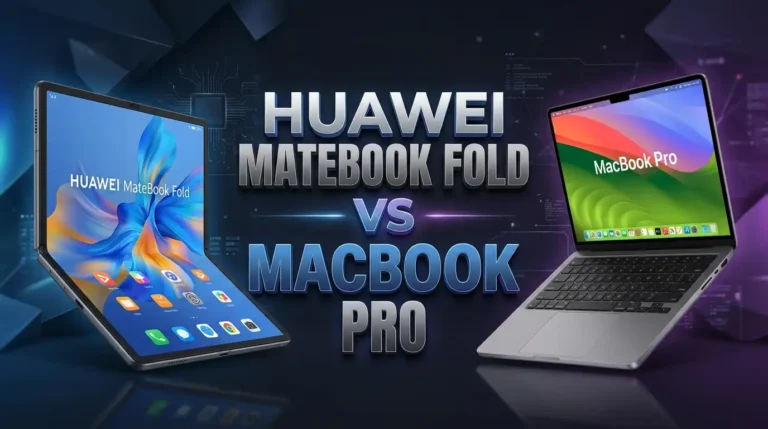

Huawei MateBook Fold vs ASUS ZenBook Duo: Which Dual Screen Laptop Wins?
Are you torn between two of the most creative laptops on the market right now? The Huawei MateBook Fold and the ASUS ZenBook Duo both push the limits of what a laptop can do. One folds in half like a book. The other hides a second screen under its keyboard.
Both promise a better way to work, create, and consume content. But they take very different paths to get there.
This comparison will break down every major detail. You will learn about their displays, processors, battery life, build quality, pricing, and more. By the end, you will know exactly which laptop fits your needs.
Key Takeaways
- The Huawei MateBook Fold offers an 18 inch foldable OLED display that shrinks down to 13 inches when folded. It weighs just 1.22 kg and targets users who want a large screen in a portable package. It runs HarmonyOS, which limits its global software compatibility.
- The ASUS ZenBook Duo delivers two 14 inch OLED touchscreens with a detachable keyboard. It runs Windows 11 and uses the Intel Core Ultra 9 285H processor. It starts at $1,599 and offers broad software support right out of the box.
- The MateBook Fold costs around $3,400 USD and is primarily available in China. The ZenBook Duo is widely available through Amazon and major retailers worldwide. The MateBook Fold wins on portability and screen size. The ZenBook Duo wins on software support, processing power, and affordability.
- Battery life is decent on both machines but neither is a marathon runner. The ZenBook Duo lasts about 8 hours and 39 minutes on a single charge. The MateBook Fold offers roughly 10 hours of light use.
- Both laptops suit professionals who need more screen space. Your choice depends on your ecosystem preference, budget, and where you live.
Huawei MateBook Fold Overview

- Multi-Screen Versatility — Find the mode that best suits your task and seamlessly switch between them. Expand your workspace with Dual...
- Everything-Built-In Portability — At 3.64 lb and a mere 0.57” thin, the DUO elevates portable dual-screen setups to the next level. With...

Last update on 2026-06-30 / Affiliate links / Images from Amazon Product Advertising API
The Huawei MateBook Fold is one of the most ambitious laptops ever made. It features an 18 inch foldable OLED display that uses a waterdrop hinge to fold flat without leaving a visible crease. When folded, it becomes a compact 13 inch device that fits easily into a bag.
The body is made from ultra light magnesium alloy with a vegan leather finish. It weighs only 1.22 kg, which is remarkable for an 18 inch device. The thickness measures just 7.3 mm when unfolded and 14.9 mm when folded. It looks and feels more like a luxury accessory than a traditional laptop.
Inside, you get 32 GB of LPDDR5X RAM and up to 2 TB of PCIe SSD storage. A six speaker spatial audio system and quad microphones handle sound and conferencing duties. The 75 Wh battery supports 140W USB-C fast charging. Huawei claims around 10 hours of light productivity use on a full charge. The main catch is the operating system. It runs HarmonyOS, not Windows.
Pros:
- Stunning 18 inch foldable OLED display with 1600 nits peak brightness
- Ultra lightweight at just 1.22 kg
- Premium build with magnesium alloy and vegan leather
- Fast 140W USB-C charging
- Nearly invisible fold crease
Cons:
- Runs HarmonyOS, not Windows
- Primarily available only in China
- Starting price around $3,400 USD
- Limited port selection with only dual USB-C
- No confirmed stylus support
ASUS ZenBook Duo Overview
- Multi-Screen Versatility — Find the mode that best suits your task and seamlessly switch between them. Expand your workspace with Dual...
- Everything-Built-In Portability — At 3.64 lb and a mere 0.57” thin, the DUO elevates portable dual-screen setups to the next level. With...
Last update on 2026-06-30 / Affiliate links / Images from Amazon Product Advertising API
The ASUS ZenBook Duo takes a completely different approach to extra screen space. Instead of folding one large display, it stacks two full 14 inch OLED touchscreens on top of each other. The keyboard is detachable and connects via Bluetooth or magnetically docks onto the lower screen.
The 2025 model uses the Intel Core Ultra 9 285H processor with Intel Arc 140T integrated graphics. It comes with 32 GB of RAM and up to 1 TB of SSD storage. Both screens run at 2,880 x 1,800 resolution with a 120 Hz refresh rate. The panels deliver vibrant OLED color with 122% sRGB coverage and a Delta E color accuracy of just 0.23.
The chassis is built from aluminum and weighs 3.8 pounds (about 1.72 kg). It measures 12.3 x 8.6 x 0.6 to 0.8 inches. A built in kickstand on the base lets you prop both screens in a stacked configuration for a desktop like experience. The ZenBook Duo starts at $1,599 and runs Windows 11.
Pros:
- Two full 14 inch OLED touchscreens with excellent color accuracy
- Runs Windows 11 with full software compatibility
- Powerful Intel Core Ultra 9 285H processor
- Detachable keyboard with Bluetooth support
- Widely available and starts at $1,599
Cons:
- Battery life is just 8 hours and 39 minutes (single screen)
- Weighs 3.8 pounds, heavier than many 14 inch laptops
- Display brightness tops out at only 330 nits
- Gets warm at the center underside (99°F)
- Dual screen mode drops battery to about 6 hours
Display Quality Comparison
The display is the star of the show on both devices. The Huawei MateBook Fold features an 18 inch LTPO OLED panel with 3,296 x 2,472 resolution (3.3K). It reaches a peak brightness of 1,600 nits and carries HDR Vivid certification. The 4:3 aspect ratio is excellent for productivity and reading. When folded, the 13 inch screen still delivers a sharp 2,472 x 1,648 resolution.
The ASUS ZenBook Duo uses dual 14 inch OLED panels at 2,880 x 1,800 resolution each. Both screens support 120 Hz refresh rates and touch input. Color accuracy is impressive at a Delta E of 0.23. However, the brightness is lower at 330 nits, which can be a challenge in brightly lit rooms.
If you value a single large immersive screen, the MateBook Fold wins. If you prefer two separate screens for multitasking, the ZenBook Duo has the advantage. The MateBook Fold is brighter and sharper. The ZenBook Duo gives you more usable screen real estate for split workflow tasks like coding, writing, or video editing.
Processor and Performance
The ASUS ZenBook Duo has a clear advantage here. Its Intel Core Ultra 9 285H processor scored 16,048 on Geekbench 6 multi core tests. That is a significant jump over the previous generation. It also completed a Handbrake video conversion in just 4 minutes and 54 seconds. SSD speeds hit 3,423 MBps write and 2,972 MBps read.
The Huawei MateBook Fold uses a Kirin X90 processor with an integrated Maleoon 910 GPU. This chip is powerful enough for office tasks, media playback, and light creative work. However, it does not match the raw performance of Intel’s latest Arrow Lake chips. Benchmark comparisons are limited because the MateBook Fold runs HarmonyOS and most standard benchmarks are built for Windows.
For heavy workloads like video editing, 3D rendering, or software development, the ZenBook Duo is the stronger choice. The MateBook Fold handles everyday productivity tasks smoothly but is not built for intense computing. Power users should lean toward the ZenBook Duo.
Operating System and Software
This is one of the biggest differences between these two laptops. The ASUS ZenBook Duo runs Windows 11, giving you access to millions of desktop applications. You can use Microsoft Office, Adobe Creative Cloud, Chrome, Slack, and virtually any software you need. It also includes the MyASUS app for system monitoring, fan profiles, OLED care, and battery management.
The Huawei MateBook Fold runs HarmonyOS 4.2 with an expected OTA update to HarmonyOS 5. This operating system works well within the Huawei ecosystem. Features like SuperHub, Multi Screen Collaboration, and cross device clipboard make it seamless to share files between Huawei phones, tablets, and the MateBook Fold.
However, HarmonyOS lacks many popular global apps. You will not find Google services, most Western productivity suites, or many third party tools. If you live outside China or depend on Windows software, the ZenBook Duo is the practical choice. If you are fully invested in Huawei’s ecosystem, the MateBook Fold provides a smooth and integrated experience.
Build Quality and Design
Both laptops push boundaries in design but take very different approaches. The Huawei MateBook Fold looks like a luxury product. Its magnesium alloy frame and vegan leather finish give it a premium feel. The waterdrop hinge is smooth and precise. At just 7.3 mm thin when unfolded, it feels impossibly sleek. The magnetic kickstand supports multiple viewing angles.
The ASUS ZenBook Duo uses a solid aluminum chassis that feels sturdy and reliable. It looks like a standard laptop when closed, which some users will prefer. The detachable keyboard magnetically locks onto the deck. A firm kickstand on the base props the laptop up for dual screen mode. The hinges on the top display can feel a bit wobbly, but this is expected for a device with this form factor.
The MateBook Fold wins on visual impact and portability. The ZenBook Duo wins on practicality and durability. Both devices feel premium in hand. Your preference will come down to whether you want something that turns heads or something that blends in.
Portability and Weight
Portability matters a lot for professionals on the go. The Huawei MateBook Fold weighs just 1.22 kg (2.69 pounds) and folds down to the size of a 13 inch laptop. That makes it one of the lightest 18 inch class devices ever built. You can slip it into a standard laptop bag without any trouble.
The ASUS ZenBook Duo weighs 3.8 pounds (1.72 kg) and measures 12.3 x 8.6 x 0.6 to 0.8 inches. For a 14 inch laptop, that is on the heavier side. The extra weight comes from the second screen and the internal structure needed to support it. You will feel the extra heft in a backpack over a long day.
The MateBook Fold is the better travel companion. It gives you a bigger screen in a lighter package. The ZenBook Duo is still portable enough for daily commutes, but it won’t disappear in your bag the way the MateBook Fold does. If you fly often or work from coffee shops, the MateBook Fold’s form factor is hard to beat.
Battery Life
Neither laptop is a battery champion, but both offer acceptable results. The Huawei MateBook Fold packs a 75 Wh battery and claims about 10 hours of light productivity use. The 140W USB-C fast charger can restore it to around 85% in under 60 minutes. That fast charging speed partially makes up for the battery life.
The ASUS ZenBook Duo also has a 75 Wh battery. It lasted 8 hours and 39 minutes on Laptop Mag’s continuous web surfing test with one screen active. With both screens turned on, battery life drops to 6 hours and 5 minutes. The 65W charger included in the box is slower than the MateBook Fold’s charger.
Battery life is the ZenBook Duo’s weak point, especially compared to last year’s model which lasted over 10 hours. The MateBook Fold offers slightly better endurance and much faster charging. If you need all day battery life from either device, carry the charger. Both laptops have enough juice for a standard work session but will need a top up by evening.
Audio and Webcam
The Huawei MateBook Fold features a six speaker spatial audio system with surround sound support. Quad AI enhanced microphones handle noise cancellation for video calls. The 8 MP front facing camera produces clear images for conferencing. Audio quality is rich and immersive for a laptop this thin.
The ASUS ZenBook Duo uses bottom firing speakers that are surprisingly loud. At 60% volume, they fill a small office easily. However, audio can get muddy at higher volumes when multiple sound elements play at the same time. The 1080p webcam produces decent but slightly undersaturated images. Colors can look a bit muted, but clarity is acceptable for video calls.
The MateBook Fold has the edge in audio quality thanks to its six speaker setup and spatial sound support. The ZenBook Duo is louder but less refined. For webcam quality, neither laptop is exceptional. If video calls are a priority for you, consider adding an external webcam to either device.
Keyboard and Input Experience
The ASUS ZenBook Duo has a detachable keyboard that magnetically attaches to the lower screen. It supports Bluetooth mode via a switch on the side. The keys are satisfyingly clicky and the typing experience is solid. One reviewer hit 123 words per minute with 100% accuracy on a typing test. The 5.1 x 2.9 inch touchpad is smooth and responsive. The half sized arrow keys are the only real complaint.
The Huawei MateBook Fold includes an optional magnetic Bluetooth keyboard that attaches when folded. It works well for quick typing sessions, but it is thinner and less tactile than the ZenBook Duo’s keyboard. When unfolded, the lower half of the screen becomes a virtual keyboard. This is functional for light input but not ideal for long writing sessions.
The ZenBook Duo offers a better typing experience overall. Its physical keyboard feels solid and responsive. The MateBook Fold’s keyboard works in a pinch but cannot match the feedback and comfort of a well built physical keyboard. If you type for hours each day, the ZenBook Duo is the smarter pick.
Port Selection and Connectivity
The ASUS ZenBook Duo offers a more complete set of ports. You get two Thunderbolt 4 ports, one USB 3.2 Gen 1 Type-A port, one HDMI 2.1 TMDS port, and a 3.5 mm audio jack. It supports Wi-Fi 7 and Bluetooth 5.4. This gives you enough connections for monitors, external drives, and peripherals without needing a hub.
The Huawei MateBook Fold keeps things minimal. It has two USB-C 3.2 Gen 1 ports that support up to 66W charging on one port. Wireless connectivity includes Wi-Fi 6E and Bluetooth 5.3. There is no HDMI, no USB-A, and no audio jack. You will likely need a USB-C hub for everyday use.
The ZenBook Duo wins this category easily. Its Thunderbolt 4 support and HDMI 2.1 port make it far more versatile for connecting external displays and accessories. The MateBook Fold’s slim design sacrifices port variety. If you rely on wired connections, the ZenBook Duo is the better equipped machine.
Pricing and Availability
Price is a major factor in this comparison. The ASUS ZenBook Duo starts at $1,599 for the Intel Core Ultra 7 model. The Intel Core Ultra 9 model with 2.8K OLED screens costs $1,699. It is widely available on Amazon, Best Buy, and the ASUS online store. Global availability is excellent.
The Huawei MateBook Fold starts at approximately $3,400 USD (¥24,999 in China). The 2 TB storage model goes for around $3,700 USD (¥26,999). Currently, the MateBook Fold is only officially available in China. There is no confirmed global launch date. Importing it adds extra cost and removes warranty support.
The ZenBook Duo offers much better value for most buyers. You get two OLED screens, a powerful processor, and Windows 11 for less than half the price of the MateBook Fold. The MateBook Fold is a premium device for a premium price, but its limited availability makes it hard to recommend outside of China.
Who Should Buy the Huawei MateBook Fold?
The MateBook Fold is perfect for a specific type of user. If you live in China or within the Huawei ecosystem, this device is a dream. The foldable 18 inch screen is stunning for presentations, media consumption, and reading documents. Its feather light weight makes it the ideal travel companion for business professionals.
Creative users who value large screen real estate without the bulk of a traditional 17 or 18 inch laptop will love this form factor. The vegan leather finish and slim profile also make it a conversation starter at any meeting table.
However, if you need Windows software, broad app support, or live outside China, the MateBook Fold is difficult to justify. It is a glimpse into the future of foldable laptops, but its ecosystem and availability limitations hold it back for a global audience.
Who Should Buy the ASUS ZenBook Duo?
- Multi-Screen Versatility — Find the mode that best suits your task and seamlessly switch between them. Expand your workspace with Dual...
- Everything-Built-In Portability — At 3.64 lb and a mere 0.57” thin, the DUO elevates portable dual-screen setups to the next level. With...
Last update on 2026-06-30 / Affiliate links / Images from Amazon Product Advertising API
The ZenBook Duo suits a wide range of users. Writers, developers, designers, and content creators will benefit from having two full screens for multitasking. You can code on one screen and preview on the other. You can edit photos on top and reference images on the bottom.
Its Windows 11 operating system and powerful Intel processor make it a capable workhorse. The price is fair for what you get. And with broad availability on Amazon and other retailers, you can buy it today and have it delivered by the end of the week.
If you want a dual screen laptop that works out of the box with all your favorite apps, the ZenBook Duo is the clear winner. Its battery life is not the best, and it is heavier than a standard ultrabook. But for the unique dual screen experience at this price point, nothing else comes close.
Frequently Asked Questions
Can the Huawei MateBook Fold run Windows apps?
No. The MateBook Fold runs HarmonyOS, which does not support Windows applications. You cannot install Windows on this device. If you need Windows software, the ASUS ZenBook Duo is the better option.
Is the ASUS ZenBook Duo good for gaming?
The ZenBook Duo is not built for gaming. Its Intel Arc 140T integrated graphics can handle light games like Civilization VI at around 56 fps on medium settings. For serious gaming, a dedicated gaming laptop is a better investment.
Does the Huawei MateBook Fold have a visible crease?
The waterdrop hinge design minimizes the fold crease significantly. Under normal lighting conditions, the crease is nearly invisible. Huawei rates the hinge for over 250,000 folds, so durability is not a concern.
Can I use the ZenBook Duo with just one screen?
Yes. You can keep the keyboard docked on the lower screen and use the ZenBook Duo as a regular laptop. The second screen activates only when you detach the keyboard or switch to stacked mode.
Which laptop has better battery life?
The Huawei MateBook Fold offers roughly 10 hours of light use. The ASUS ZenBook Duo lasts about 8 hours and 39 minutes with one screen active. The MateBook Fold also charges faster with its 140W charger compared to the ZenBook Duo’s 65W charger.
Is the Huawei MateBook Fold available in the US?
The MateBook Fold is currently exclusive to the Chinese market. There is no official global release date. You may find import options, but these come with extra cost and no official warranty support.
Which laptop is better for professionals?
It depends on your priorities. The ZenBook Duo is better for professionals who need Windows software, strong processing power, and dual screen multitasking. The MateBook Fold is better for professionals in the Huawei ecosystem who value extreme portability and a large foldable display.

Hi there! I’m Jinny, the tech enthusiast behind GadgetInsight. I spend my days unboxing the newest devices, diving deep into their features, and figuring out how they can genuinely improve your life – or if they’re worth your hard-earned money at all.