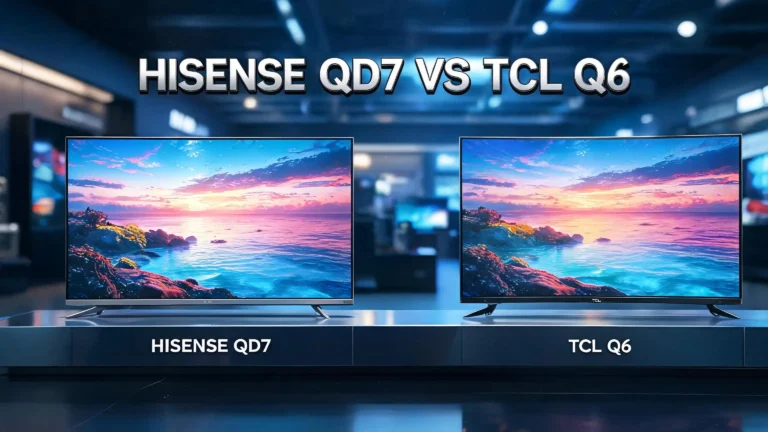
Hisense QD7 vs TCL QM6K: The Ultimate Budget Mini-LED TV Showdown
Shopping for a budget 4K TV can feel overwhelming. Two names keep popping up in every conversation: the Hisense QD7 and the TCL QM6K.
Both TVs promise stunning Mini-LED picture quality at prices that won’t drain your wallet. But which one actually delivers more value for your money?
In this detailed comparison, I break down every important spec, feature, and real-world performance metric. By the end, you will know exactly which TV suits your room, your habits, and your budget. Let’s dive in.
Key Takeaways
- The TCL QM6K edges ahead in several critical areas. It offers better local dimming with up to 500 dimming zones compared to the Hisense QD7’s more limited zone count. This gives the TCL deeper blacks and better contrast in dark scenes.
- The Hisense QD7 runs on Amazon Fire TV, while the TCL QM6K runs on Google TV. Your preference for a smart TV platform could be a deciding factor here. Google TV offers a wider app library, but Fire TV integrates well with Alexa and Amazon devices.
- Both TVs support a 144Hz refresh rate in game mode. However, the TCL QM6K includes HDMI 2.1 ports as standard across all sizes. Some smaller Hisense QD7 models only feature HDMI 2.0 ports, which limits bandwidth for gaming.
- The TCL QM6K costs slightly more at around $530 to $650 for the 65-inch model. The Hisense QD7 65-inch can be found for roughly $450 to $500. That $50 to $150 difference might matter for tight budgets.
- For dark room viewing, the TCL QM6K is the stronger pick. For bright room casual viewing on a tighter budget, the Hisense QD7 still holds its own. Both TVs deliver impressive value for their price range in 2026.
Hisense QD7: Overview and First Impressions

- MINILED | UP TO 600 NITS PEAK BRIGHTNESS: See more contrast on the field and off. Lots of tiny LEDs make a major difference when it comes to...
- QLED COLOR: See the exact hue of every blade of grass on the field and every line on the court. QLED Color is made up of quantum dots—very...
Last update on 2026-10-25 / Affiliate links / Images from Amazon Product Advertising API
The Hisense QD7 is a budget-friendly Mini-LED QLED TV that launched in 2025. It runs on Amazon Fire TV and comes with Alexa built in. You can find it in sizes ranging from 50 inches all the way up to 100 inches.
This TV uses Quantum Dot technology to produce over a billion color shades. It supports HDR10+, Dolby Vision, and Dolby Atmos, which means both the picture and sound benefit from modern standards. The design is slim and clean with minimal bezels around the screen.
Hisense positions the QD7 as an everyday TV for families. It handles streaming, sports, and casual gaming well. The Fire TV interface gives you quick access to apps like Netflix, Prime Video, Disney+, and more. Voice control through Alexa makes searching for content easy.
The build quality feels solid for the price. The remote is simple and responsive. Setup takes about 10 minutes from unboxing to your first show.
Pros:
- Very affordable price point across all sizes
- Mini-LED backlighting with Full Array Local Dimming
- Dolby Vision and Dolby Atmos support
- Alexa built in with Fire TV integration
- Available in sizes up to 100 inches
Cons:
- Smaller models limited to HDMI 2.0 and 60Hz
- Lower peak brightness compared to TCL QM6K
- Fire TV platform shows more ads than Google TV
- Image processing struggles with low-quality streams
TCL QM6K: Overview and First Impressions

- TCL QM6K QD-MINI LED TV SERIES - AFFORDABLE PREMIUM PERFORMANCE FOR SPORTS, GAMING & STREAMING. Experience superior contrast, rich color...
- QD-MINI LED. IT’S MINI LED PLUS QLED COLOR - BREATHTAKING BRIGHTNESS AND COLOR IN ANY LIGHT. Combines ultra-precise Mini LEDs with Quantum...

Last update on 2026-10-25 / Affiliate links / Images from Amazon Product Advertising API
The TCL QM6K is a 2025 QD-Mini LED TV that runs on Google TV. It comes in 55, 65, 75, 85, and 98-inch sizes. TCL markets it as a premium viewing experience at an entry-level price.
This TV uses TCL’s LD500 Precise Dimming system with up to 500 local dimming zones. That is a significant number for a budget TV. It also features a High Contrast HVA panel and supports Dolby Vision, HDR10+, and Dolby Atmos through Onkyo-tuned speakers.
The QM6K runs Google TV, which gives you access to a huge library of apps. You get Chromecast built in, Google Assistant, and smooth integration with other Google devices. The interface is clean and easy to browse.
CNET called the QM6K one of the best values in its price range. Reviewers praised its black levels and contrast performance, which are unusual strengths for a budget TV.
Pros:
- Up to 500 local dimming zones for deep blacks
- 144Hz refresh rate with HDMI 2.1 across all sizes
- Google TV platform with Chromecast built in
- Onkyo-tuned speakers with Dolby Atmos
- Strong color accuracy out of the box
Cons:
- Slightly higher price than the Hisense QD7
- No ATSC 3.0 tuner included
- Viewing angles could be better on the HVA panel
- Speakers lack deep bass despite Onkyo tuning
Picture Quality: Brightness and HDR Performance
Brightness is a major factor for anyone watching TV in a living room with windows. The TCL QM6K delivers higher peak brightness in both SDR and HDR modes. It can push past 1,000 nits in small highlights during HDR content.
The Hisense QD7 reaches around 600 nits on average in HDR, based on reviews from Tom’s Guide and RTINGS. This is decent for casual viewing. However, it falls short in very bright rooms where glare can wash out the picture.
HDR content looks noticeably more punchy and dynamic on the TCL QM6K. Highlights in movies like sunsets, explosions, and reflections pop with more intensity. The Hisense still handles HDR content well, but the difference is visible in a side-by-side comparison.
Both TVs support Dolby Vision and HDR10+, so you get the best HDR formats regardless of which one you pick. For pure brightness performance, the TCL QM6K takes the lead.
Contrast and Black Levels
This is where the gap between the two TVs becomes very clear. The TCL QM6K has far superior black levels thanks to its 500 local dimming zones and High Contrast HVA panel. Dark scenes in movies and shows look rich and inky.
The Hisense QD7 does have Mini-LED backlighting with Full Array Local Dimming. However, it has fewer dimming zones than the TCL. This means dark scenes can appear slightly gray or washed out in comparison.
If you watch a lot of movies at night or enjoy dark, cinematic content, the TCL QM6K will satisfy you more. Shows like House of the Dragon or The Batman look significantly better on the QM6K because shadow details are preserved without blooming.
The Hisense QD7 performs fine for bright, colorful content like animated movies or daytime sports. For dark room performance, the TCL QM6K is the clear winner here.
Color Accuracy and Quantum Dot Performance
Both TVs use Quantum Dot technology to enhance color range and vibrancy. You get over a billion color shades on each panel. Reds look deep, blues look rich, and greens pop with natural intensity.
The TCL QM6K has a slight edge in out-of-the-box color accuracy. Multiple reviewers noted that the QM6K in Filmmaker Mode produces colors close to reference standards. You won’t need to spend time calibrating it to get a good picture.
The Hisense QD7 also delivers vivid and saturated colors. Some users on Reddit noted that the QD7 can even look slightly more vivid than the TCL in certain modes. The difference here is small and comes down to personal preference.
Wide color gamut coverage is strong on both TVs. For streaming content, gaming, and sports, both sets produce eye-catching images. If accurate, natural color is your priority, the TCL QM6K has a minor advantage.
Gaming Performance and Input Lag
Gamers will find plenty to like about both TVs. The TCL QM6K includes HDMI 2.1 ports across all sizes, which supports 4K at 120Hz gameplay. It also features a 144Hz refresh rate in game mode and TCL’s Game Accelerator 288 technology.
The Hisense QD7’s gaming performance varies by model size. Larger models (75 inches and up) offer 144Hz and HDMI 2.1. Smaller models are limited to 60Hz and HDMI 2.0. This is a big deal for PS5 and Xbox Series X owners who want full next-gen performance.
Both TVs support ALLM (Auto Low Latency Mode) and VRR (Variable Refresh Rate). Input lag on both sets is low enough for responsive gaming. The TCL QM6K has been praised by RTINGS for having very good gaming performance overall.
If you are a serious gamer and want a guaranteed 120Hz experience regardless of screen size, the TCL QM6K is the safer choice. The Hisense QD7 works great for gaming too, but check the specific model specs before buying.
Smart TV Platform: Fire TV vs Google TV
The Hisense QD7 uses Amazon Fire TV as its operating system. Fire TV has a familiar interface if you already use Amazon products. It features Alexa voice control, quick access to Prime Video, and a solid app selection.
The TCL QM6K uses Google TV, which is based on Android TV. Google TV offers a larger app library, Chromecast built in, and Google Assistant. It also provides personalized recommendations based on your viewing history across streaming services.
Fire TV tends to show more sponsored content and ads on the home screen. Google TV is cleaner but still includes some suggestions. Both platforms support all major streaming apps including Netflix, Hulu, Disney+, Apple TV+, and YouTube.
Your existing ecosystem matters here. If you own Echo devices and shop on Amazon, Fire TV fits right in. If you use Android phones, Chromecasts, or Google Home speakers, Google TV will feel more natural. Neither platform is bad. It comes down to personal preference.
Sound Quality and Audio Features
Both TVs support Dolby Atmos for spatial audio. The TCL QM6K features Onkyo-tuned speakers, which deliver a wider soundstage than you might expect from a budget TV. Dialogue sounds clear, and there is decent mid-range presence.
The Hisense QD7 also has competent built-in speakers. They handle everyday TV watching, news, and casual streaming just fine. However, neither TV produces deep bass or room-filling sound on its own.
If you care about audio quality, a soundbar is a worthwhile addition to either TV. Both sets have eARC support through their HDMI ports, which means they can pass high-quality audio to an external sound system.
For built-in speaker quality alone, the TCL QM6K has a slight edge thanks to the Onkyo partnership. But the difference is not dramatic enough to be a deciding factor between the two TVs.
Design and Build Quality
The Hisense QD7 has a clean, modern design with thin bezels. It sits on two wide-set feet that provide stable support. The TV is relatively thin for a Mini-LED set. The overall look is sleek and works well in most living rooms.
The TCL QM6K also sports a minimalist design with slim bezels. It is a lighter TV than many competitors in its class. TCL’s build quality has improved greatly in recent years. The QM6K feels solid without being bulky.
Both TVs can be wall-mounted using standard VESA patterns. The cable management options are basic on both. Neither TV stands out dramatically in design. They both look like modern, premium-ish TVs that blend into your room without drawing attention.
The TCL QM6K remote is clean and includes a Google Assistant button. The Hisense QD7 remote has dedicated streaming buttons and an Alexa voice button. Both remotes are comfortable and functional.
Size Options and Pricing
The Hisense QD7 comes in 50, 55, 65, 75, 85, and 100-inch sizes. This gives you the most flexibility if you need a very large or very small screen. The 65-inch model typically sells for around $450 to $500.
The TCL QM6K is available in 55, 65, 75, 85, and 98-inch sizes. The 65-inch model usually costs between $530 and $650 depending on sales and retailer. The TCL tends to be $50 to $150 more than the comparable Hisense size.
For budget shoppers, the Hisense QD7 offers better value per dollar. You get a capable Mini-LED TV for less money. The TCL QM6K costs a bit more but justifies the price with better picture processing, local dimming, and consistent HDMI 2.1 support.
Both TVs go on sale frequently. Check Amazon, Best Buy, and Walmart for the best deals. Black Friday and Prime Day events often bring both TVs to their lowest prices.
Viewing Angles and Off-Axis Performance
Neither TV excels in this area. The TCL QM6K uses an HVA panel, which offers better contrast at the cost of narrower viewing angles. Colors and brightness drop off noticeably if you sit far to the side.
The Hisense QD7 also uses a VA-type panel with similar viewing angle limitations. If your couch is directly in front of the TV, this won’t be an issue. For wide seating arrangements, both TVs lose image quality off-axis.
If you frequently watch TV from different spots in the room, neither of these TVs is ideal. An IPS panel TV or an OLED would serve that use case better. For most people who sit directly in front of the screen, the viewing angle limitation is a non-issue on both sets.
Which TV Should You Buy?
The answer depends on your priorities. If you want the best overall picture quality, deeper blacks, and consistent gaming specs, the TCL QM6K is the better TV. It wins on contrast, brightness, and processing quality.
If your budget is tight and you want a large-screen Mini-LED TV for the lowest price, the Hisense QD7 gives you great value. It handles casual viewing, sports, and family entertainment well. The Fire TV platform works perfectly for Amazon households.
For dark room movie watching, pick the TCL QM6K. For bright room casual viewing on a budget, the Hisense QD7 does the job. Both TVs punch above their weight class in 2026. You can’t go terribly wrong with either one.
Frequently Asked Questions
Is the TCL QM6K worth the extra money over the Hisense QD7?
Yes, for most buyers, the TCL QM6K justifies its higher price. You get better local dimming, higher peak brightness, and HDMI 2.1 on every size. The improved contrast and black levels make a visible difference, especially in darker content. If your budget allows, the QM6K is the smarter investment.
Can I use the Hisense QD7 for PS5 or Xbox Series X gaming?
You can, but you need to pick the right size. The 75-inch and larger models offer 144Hz and HDMI 2.1 for full next-gen gaming. Smaller models are limited to 60Hz and HDMI 2.0, which means no 4K at 120fps. The TCL QM6K avoids this issue with HDMI 2.1 on all sizes.
Which TV has better sound quality out of the box?
The TCL QM6K has a slight advantage thanks to Onkyo-tuned speakers. Both TVs support Dolby Atmos, and both benefit from adding a soundbar. Built-in speakers on budget TVs are generally average, so a soundbar upgrade is recommended for either model.
Do both TVs support Dolby Vision and HDR10+?
Yes. Both the Hisense QD7 and TCL QM6K support Dolby Vision, HDR10+, and HDR10. This means you will get the best HDR experience from all major streaming platforms and Blu-ray discs, regardless of which TV you choose.
Which TV is better for a bright living room?
The TCL QM6K handles bright rooms better because of its higher peak brightness. It fights glare more effectively and keeps the picture punchy under ambient light. The Hisense QD7 works fine in moderately lit rooms but struggles more with direct sunlight or strong overhead lighting.

Hi there! I’m Jinny, the tech enthusiast behind GadgetInsight. I spend my days unboxing the newest devices, diving deep into their features, and figuring out how they can genuinely improve your life – or if they’re worth your hard-earned money at all.