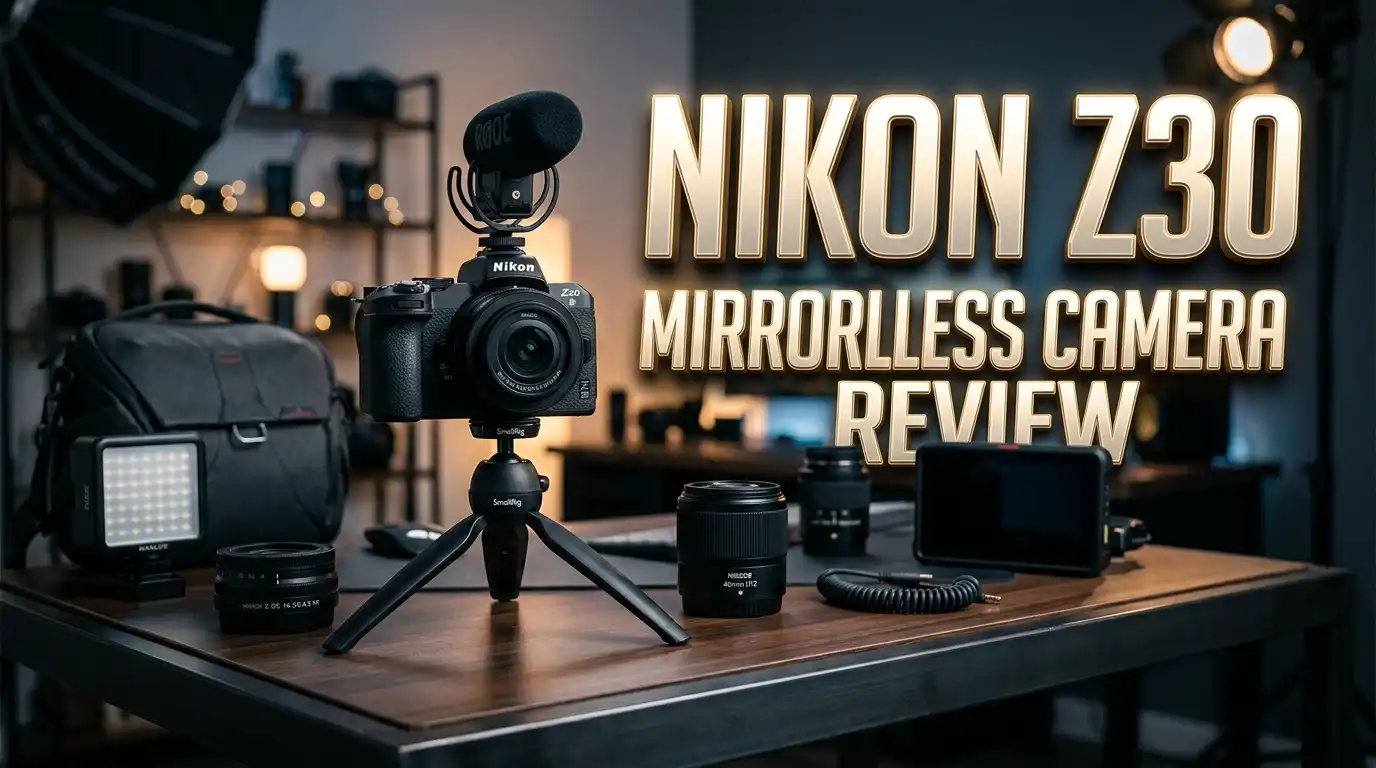
Nikon Z30 Mirrorless Camera Review 2026: Worth Buying?
The Nikon Z30 first hit the market in 2022 as Nikon’s most compact mirrorless camera. Fast forward to 2026, and this little powerhouse still holds its own.
Vloggers, content creators, and beginner photographers continue to pick it up off the shelves. But does it truly deserve your money in 2026?
This camera was built with one clear purpose. It wants to make video creation simple and fun. It has a 20.9MP APS-C sensor, records 4K video at 30fps, and weighs just 405 grams. That makes it lighter than most smartphones with a case.
In this review, we break down everything you need to know about the Nikon Z30. We cover image quality, video performance, battery life, autofocus, and much more.
Key Takeaways
- The Nikon Z30 is Nikon’s smallest and lightest Z-mount mirrorless camera. It weighs just 405 grams with the battery and memory card. This makes it a perfect travel and vlogging companion that won’t weigh down your bag or tire out your arms during long shoots.
- It records 4K UHD video at 30fps with no crop. You get the full width of the sensor during 4K recording. That is a big deal for vloggers who want a wide field of view without buying an extra wide-angle lens.
- The 20.9MP APS-C CMOS sensor paired with the EXPEED 6 processor delivers sharp, clean images. It handles low-light situations well up to ISO 6400. Photos look vibrant and detailed straight out of the camera.
- Battery life is the camera’s weakest point. The EN-EL25 battery is rated for about 330 shots or roughly 75 minutes of video. Heavy video creators will need at least one spare battery.
- The fully articulating touchscreen flips 180 degrees for selfie-style vlogging. There is no electronic viewfinder, which saves weight but may frustrate traditional photographers.
- The hybrid autofocus system with eye-detection AF tracks faces and eyes reliably. It works well for solo creators who need to stay in focus while talking to the camera.
Nikon Z30 Design and Build Quality

- Designed for creators, vloggers and streamers: Nikon's easy to use Z 30 mirrorless 4K camera body (lenses sold separately)
- Pro-grade video quality: Crisp 4K resolution, autofocus with eye tracking for people and pets, beautifully blurred backgrounds and...

Last update on 2026-07-20 / Affiliate links / Images from Amazon Product Advertising API
The Nikon Z30 has a polycarbonate body that feels surprisingly solid for its size. It measures just 128 x 74 x 60mm. You can easily hold it in one hand or mount it on a small gimbal without issues.
Nikon removed the electronic viewfinder from this model. That decision keeps the body slim and the weight down. The camera weighs only 405 grams with the battery and card slot filled.
The grip is small but ergonomic enough for comfortable one-handed shooting. Buttons are placed within easy reach of your thumb and index finger. The dedicated video record button sits right on top where you need it.
A red tally light on the front of the camera tells you when recording is active. This is a smart touch for solo creators who can’t always check the screen. The build quality is not weather-sealed, so you should avoid rain and heavy dust.
Nikon Z30 Sensor and Image Quality
The Nikon Z30 uses a 20.9-megapixel APS-C (DX-format) CMOS sensor. This is the same sensor found in the Nikon Z50. It delivers excellent detail and color accuracy for a camera at this price point.
ISO performance is solid from ISO 100 to ISO 6400. You can push it to ISO 12800 in a pinch, but noise becomes more visible. Daytime photos are sharp, punchy, and full of natural color.
The EXPEED 6 image processor handles data quickly. It allows the camera to shoot at 11 frames per second in burst mode. That is fast enough to capture action shots of pets, kids, or street scenes.
Dynamic range is good but not exceptional. You can recover about 2 to 3 stops of shadow detail in RAW files. Highlights hold up well too. For the price, the Nikon Z30 takes photos that easily compete with cameras costing hundreds more.
Nikon Z30 Video Performance
Video is where the Nikon Z30 truly shines. It records 4K UHD at 30fps using the full width of the sensor. There is no crop during 4K recording. That gives you a wider field of view compared to many competitors.
Full HD recording goes up to 120fps for slow-motion footage. This is great for creative B-roll or dramatic effect shots. The camera can also record up to 125 minutes of continuous video in 1080p at lower frame rates.
There is no 30-minute recording limit at most resolutions. This sets it apart from older cameras that forced you to stop and restart. The camera uses an H.264 codec and stores files in MOV or MP4 format.
Audio quality from the built-in stereo microphone is decent for casual clips. But serious creators will want to plug in an external microphone through the 3.5mm jack for cleaner sound.
Top 3 Alternatives for the Nikon Z30
1. Sony ZV-E10 II

- Exmor R CMOS sensor: The ZV-E10 II features Sony's most advanced sensor technology in an APS-C back-illuminated Exmor R CMOS image sensor...
- Interchangeable lenses to capture your vision : From the G Master series, which blends breathtaking resolution with exquisite bokeh, to the...
Last update on 2026-07-20 / Affiliate links / Images from Amazon Product Advertising API
The Sony ZV-E10 II is a direct rival to the Nikon Z30. It packs a 26MP APS-C sensor and shoots 4K at 30fps with 10-bit color depth. The Sony lens ecosystem is larger. Autofocus is lightning fast with real-time tracking. This is an excellent pick for creators who want more video features and better color science out of the box.
2. Canon EOS R50

- High Image Quality: Canon EOS R50 4K digital camera features a 24.2 Megapixel CMOS (APS-C) sensor and DIGIC X processor for stunning image...
- High-Speed Continuous Shooting: Capture fast action with up to 12 fps with Electronic First Curtain shutter and up tp 15 fps with Electronic...
Last update on 2026-07-20 / Affiliate links / Images from Amazon Product Advertising API
The Canon EOS R50 offers a 24.2MP APS-C sensor and Canon’s Dual Pixel CMOS AF II. It includes an electronic viewfinder, which the Nikon Z30 lacks. Video tops out at 4K 30fps with a slight crop. Canon’s color science produces warm, flattering skin tones. This is a great hybrid camera for people who shoot both photos and video equally.
3. Fujifilm X-S20

- X-S20 offers the perfect blend of power and portability to turn thoughts and ideas into reality. Weighing just 491g (1.08 lb), with a deep...
- X-S20 combines powerful sensor and processor technologies to deliver a blistering performance for stills and video—allowing you to capture...
Last update on 2026-07-20 / Affiliate links / Images from Amazon Product Advertising API
The Fujifilm X-S20 steps up the game with a 26.1MP sensor and Fujifilm’s famous film simulation modes. It records 6.2K video and offers in-body image stabilization. The price is higher than the Nikon Z30, but you get a lot more creative tools. Battery life is also significantly better. If budget allows, this is a strong upgrade.
Nikon Z30 Autofocus System
The Nikon Z30 features a hybrid autofocus system with 209 focus points. It covers a large portion of the frame. The camera uses both phase-detection and contrast-detection AF methods.
Eye-detection autofocus is the standout feature here. It locks onto human and animal eyes with impressive accuracy. For vloggers filming themselves, this means your face stays sharp even as you move around.
The autofocus performs well in good light. It does slow down in very dark conditions, but it still manages to find focus. Tracking a moving subject works reliably for walking shots or casual sports.
One limitation is the lack of subject-recognition AF for vehicles or birds. Newer cameras in this price range have started adding those features. Still, for faces and general subjects, the Z30’s autofocus gets the job done.
Nikon Z30 Screen and Viewfinder
The Nikon Z30 has a 3.0-inch fully articulating touchscreen with 1.04 million dots. You can flip it to face forward for selfie-style vlogging. You can also tilt it to various angles for high or low-angle shots.
The touchscreen is responsive. You can tap to focus, swipe through images, and adjust settings through the menu. The display is bright enough for indoor use and decent in outdoor sunlight, though it can wash out in very bright conditions.
There is no electronic viewfinder on this camera. Nikon made this choice to reduce size and cost. If you shoot primarily video and use the rear screen, you won’t miss it. But photographers who prefer composing through a viewfinder should consider the Nikon Z50 instead.
The screen also supports live streaming at 60fps through a USB connection. This turns the Z30 into a high-quality webcam for meetings or live content.
Nikon Z30 Battery Life and Charging
Battery life is the Nikon Z30’s biggest weakness. The EN-EL25 battery is small. Nikon rates it for approximately 330 shots or about 75 minutes of video recording.
Real-world usage often falls below those numbers. DPReview reported about 65 minutes of actual video recording during their testing. Reddit users have noted even shorter battery spans during continuous 4K shooting.
The camera supports USB-C charging, which is convenient. You can top up the battery between shoots using a portable power bank. This helps extend your shooting day.
Buying a spare battery is almost mandatory if you plan to shoot video regularly. The EN-EL25 batteries are affordable and lightweight. Carrying two or three in your bag solves the battery problem entirely.
Nikon Z30 Lens Compatibility

- Designed for creators, vloggers and streamers: Nikon's easy to use Z 30 mirrorless 4K camera with a versatile 16-50mm wide-angle zoom lens
- Pro-grade video quality: Crisp 4K resolution, autofocus with eye tracking for people and pets, beautifully blurred backgrounds, outstanding...
Last update on 2026-07-20 / Affiliate links / Images from Amazon Product Advertising API
The Nikon Z30 uses the Nikon Z-mount system. This gives you access to over 40 native NIKKOR Z lenses. The range covers everything from ultra-wide zooms to telephoto primes.
The most popular kit lens is the NIKKOR Z DX 16-50mm f/3.5-6.3 VR. It is compact, sharp, and has built-in vibration reduction. This lens pairs perfectly with the Z30’s small body.
For wider vlogging shots, the NIKKOR Z DX 12-28mm f/3.5-5.6 PZ VR is an excellent choice. It gives you a power zoom with smooth, motorized zoom control during video recording.
You can also use Nikon’s FTZ adapter to mount older F-mount lenses. This opens up a huge library of affordable used glass. The adapter adds some bulk, but it gives the Z30 access to decades of Nikon lenses.
Nikon Z30 for Vlogging and Content Creation
The Nikon Z30 was built for creators from the ground up. Every design choice points toward easy, fast video production. The flip-out screen, front tally light, and dedicated record button all serve this purpose.
Self-recording mode makes vlogging effortless. The camera automatically applies a wider crop and smoother autofocus when you flip the screen forward. This ensures you stay framed and in focus while talking.
Creative Picture Controls let you apply filters and color effects in-camera. You get 20 different looks to choose from. This saves editing time for creators who want to publish quickly.
The camera also supports in-camera time-lapse recording. You can create time-lapse videos without any additional software. This is perfect for travel content or behind-the-scenes clips.
Nikon Z30 Connectivity Features
The Nikon Z30 offers solid wireless connectivity. It has Bluetooth and Wi-Fi built in. You can transfer photos and videos to your smartphone through the Nikon SnapBridge app.
SnapBridge allows remote shooting from your phone. You can adjust settings, trigger the shutter, and preview the composition on your phone screen. This is useful for group photos or tripod-mounted shots.
The camera has a micro-HDMI output for connecting to external monitors or recorders. A USB-C port handles data transfer and charging. The 3.5mm microphone input accepts external audio sources.
There is no headphone jack for audio monitoring. This is a notable omission for video creators who want to check audio levels during recording. You will need an external recorder or an HDMI monitor with audio output for that.
Nikon Z30 Pros and Cons
Pros:
- Ultra-compact and lightweight body at just 405 grams
- Full-width 4K 30fps video with no crop
- Fully articulating touchscreen for vlogging
- Eye-detection AF works reliably for solo creators
- Compatible with 40+ native Z-mount lenses
- No video recording time limit at most resolutions
- Affordable entry point into the Nikon Z system
Cons:
- Short battery life that requires spare batteries
- No electronic viewfinder
- No in-body image stabilization
- Limited subject-detection AF compared to newer models
- No headphone jack for audio monitoring
- Polycarbonate body lacks weather sealing
Who Should Buy the Nikon Z30 in 2026?
The Nikon Z30 is ideal for vloggers, YouTube creators, and social media content makers who need a lightweight camera with excellent video quality. It delivers great 4K footage and reliable autofocus at a very competitive price.
Beginner photographers will also enjoy the Z30’s simple menu system and automatic shooting modes. The learning curve is gentle. You can grow into more advanced settings as your skills improve.
Travel photographers who want a small, light camera for casual shooting will find the Z30 very appealing. It fits in a jacket pocket with the 16-50mm kit lens. That makes it a real grab-and-go camera.
The Z30 is not the best pick for sports or wildlife photography. It lacks the fast autofocus tracking and high burst rates that action shooters need. It also isn’t ideal for professional portrait or studio work.
Nikon Z30 Pricing and Value in 2026
The Nikon Z30 body retails for about $607 to $710 depending on the seller. The kit with the 16-50mm lens costs around $850. The dual-lens kit with the 16-50mm and 50-250mm sells for approximately $1,050.
In 2026, this pricing represents outstanding value. You get a capable APS-C mirrorless camera with professional-grade video features. Competing cameras from Sony and Canon sit at similar or higher price points.
The used market has also made the Z30 more affordable. You can find excellent condition bodies for under $500. This makes it one of the cheapest ways to enter the Nikon mirrorless ecosystem.
For the features you receive, the Nikon Z30 offers one of the best price-to-performance ratios among entry-level mirrorless cameras in 2026.
Nikon Z30 Final Verdict
The Nikon Z30 remains a smart buy in 2026 for creators on a budget. Its video capabilities still hold up against newer competitors. The compact body, reliable autofocus, and full-width 4K recording make it a joy to use.
Battery life is the one area where you’ll need to plan ahead. Grab a spare battery and you’ll be fine for full shooting days. The lack of a viewfinder and in-body stabilization are trade-offs for the small size and low price.
If you create content for YouTube, TikTok, Instagram, or any other platform, the Z30 deserves a spot on your shortlist. It does what it was built to do, and it does it very well. For pure photography, the Nikon Z50 II might serve you better. But for video-first creators, the Nikon Z30 is still one of the best options under $1,000.
Frequently Asked Questions
Is the Nikon Z30 good for beginners in 2026?
Yes, the Nikon Z30 is an excellent camera for beginners. It has a simple menu system and automatic modes that help new users get great results. The camera guides you through settings with on-screen help. As you learn, you can switch to manual controls for more creative freedom.
Does the Nikon Z30 have image stabilization?
The Nikon Z30 does not have in-body image stabilization. However, several NIKKOR Z lenses include optical vibration reduction (VR) built into the lens. The 16-50mm kit lens has VR. You can also enable electronic VR in video mode, though this adds a slight crop to the frame.
Can the Nikon Z30 shoot in RAW format?
Yes, the Nikon Z30 shoots in both JPEG and NEF (RAW) format. RAW files give you much more flexibility during post-processing. You can adjust white balance, exposure, and color in software like Adobe Lightroom without losing quality.
How long can the Nikon Z30 record video continuously?
The Nikon Z30 can record up to 125 minutes of continuous video at 1080p and about 35 minutes at 4K UHD. There is no arbitrary recording time limit. The actual recording duration depends on battery charge, ambient temperature, and storage card capacity.
Is the Nikon Z30 worth buying over the Sony ZV-E10 II?
Both cameras are excellent for content creation. The Nikon Z30 is more affordable and offers full-width 4K with no crop. The Sony ZV-E10 II has a newer sensor, 10-bit video, and faster autofocus. If budget is your priority, the Z30 wins. If you want the latest features, the Sony is the stronger choice.
Does the Nikon Z30 work as a webcam?
Yes, the Nikon Z30 can function as a high-quality webcam. Connect it to your computer through USB-C and it streams at up to 1080p 60fps. No additional software is needed on most modern operating systems. This makes it a great option for Zoom calls, live streaming, and online classes.

Hi there! I’m Jinny, the tech enthusiast behind GadgetInsight. I spend my days unboxing the newest devices, diving deep into their features, and figuring out how they can genuinely improve your life – or if they’re worth your hard-earned money at all.