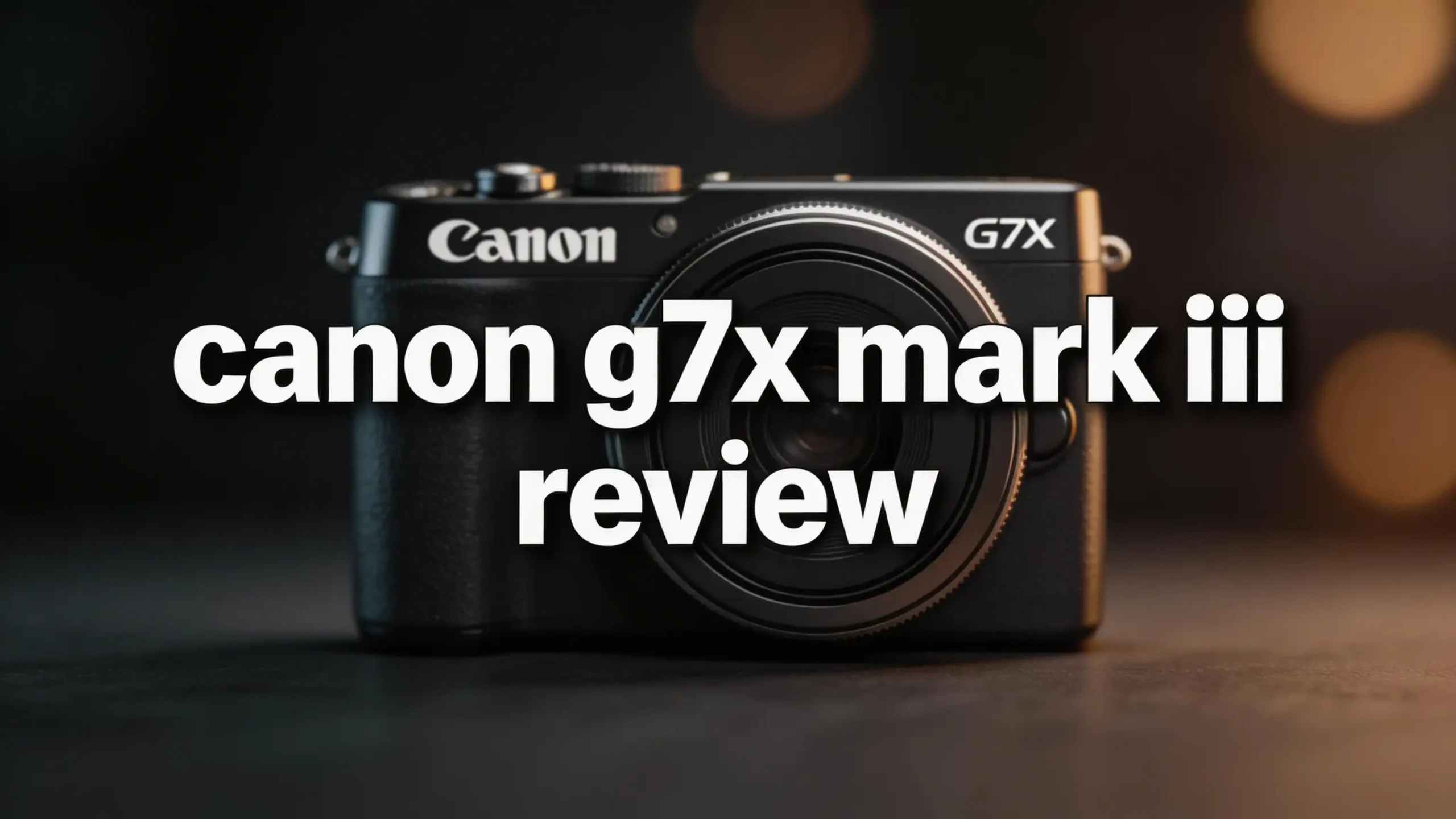
Canon G7X Mark III Review 2026: Still Worth Buying?
The Canon G7X Mark III has been a fan favorite since its launch in 2019. It showed up on TikTok wishlists, YouTube gear guides, and travel packing lists across the globe. But now, in 2026, a big question remains. Is this pocket camera still a smart buy?
Compact cameras have grown a lot in recent years. Smartphones keep getting better. New competitors have entered the market. Yet the G7X Mark III continues to sell at a strong pace.
In this detailed review, we break down everything you need to know about the Canon PowerShot G7X Mark III in 2026. We cover image quality, video performance, battery life, design, and much more.
Key Takeaways
- The Canon G7X Mark III packs a 20.1MP 1.0-inch stacked CMOS sensor with a DIGIC 8 image processor. This combination delivers sharp, vibrant photos in most lighting conditions and solid low light results for a camera this size.
- It shoots 4K video at 30fps and 1080p at 120fps. This makes it a strong choice for vloggers, content creators, and casual filmmakers who want smooth slow motion footage without carrying a bulky camera.
- The 4.2x optical zoom lens covers a 24-100mm focal length range with an impressive f/1.8-2.8 maximum aperture.
- Battery life sits at about 235 to 320 shots per charge, depending on usage. This is a known weak point of the camera.
- Wi-Fi, Bluetooth, and YouTube live streaming support come built in. The camera connects to your phone quickly and can even stream live video directly to YouTube, a feature that still stands out in 2026.
- At around $799 to $879 in 2026, the G7X Mark III is not cheap for a compact camera. However, its combination of photo quality, video features, and pocket-friendly size still makes it one of the best value compact cameras on the market.
Canon PowerShot G7X Mark III: Build and Design

- 20.1 Megapixel 1.0” stacked CMOS sensor and DIGIC 8 Image processor.
- 4.2x optical zoom Lens (24-100mm f/1.8-2.8) with optical image Stabilizer.
The Canon G7X Mark III weighs just 304 grams with the battery and memory card inside. It measures 4.13 x 2.4 x 1.6 inches. You can slide it into a jacket pocket or a small bag without any trouble.
The body uses a mix of metal and high-quality plastic. It feels solid in hand despite its small size. The textured grip on the front gives you a secure hold during one-handed shooting. Canon kept the design clean and minimal.
The 3-inch touchscreen tilts 180 degrees upward. This makes it perfect for selfies and vlogging. The touchscreen responds quickly and lets you tap to focus or swipe through your photos with ease.
One thing missing is an electronic viewfinder. In bright sunlight, you may struggle to see the screen clearly. This is a trade-off Canon made to keep the camera compact. For most users, the tilting touchscreen works just fine.
20.1MP Sensor and Image Quality
The heart of the G7X Mark III is its 20.1 megapixel 1.0-inch stacked CMOS sensor. This sensor type is larger than what most smartphones offer. It captures more light and produces cleaner images with finer detail.
Colors come out rich and accurate. Canon’s color science has always been a strong point, and the G7X Mark III shows it. Skin tones look natural, landscapes pop, and whites stay clean.
In good lighting, photos are sharp from edge to edge. The DIGIC 8 processor handles noise reduction well, keeping images smooth at lower ISO settings. At higher ISOs (above 1600), you will notice some grain. But the results remain very usable up to ISO 3200.
Dynamic range is decent for a 1-inch sensor camera. You can recover some shadow detail in post-processing. Overall, the image quality still holds up well against newer compact cameras in 2026.
Lens Performance: 24-100mm f/1.8-2.8
The built-in lens is one of the G7X Mark III’s biggest strengths. It covers a 24-100mm equivalent focal length with a 4.2x optical zoom. The f/1.8 aperture at the wide end is exceptionally fast for a compact camera.
This wide aperture lets in a lot of light. It also creates a pleasant shallow depth of field effect for portraits and close-up shots. At 100mm, the aperture narrows to f/2.8, which is still quite fast.
The optical image stabilizer helps reduce camera shake. It works well for handheld shooting at slower shutter speeds. You can shoot at 1/10 of a second and still get sharp results in many cases.
Close-up performance is also good. The minimum focusing distance lets you get quite close to subjects. Food, flowers, and product photos look great with the natural background blur this lens provides.
Top 3 Alternatives for Canon G7X Mark III
1. Sony ZV-1

- 20.1MP stacked back illuminated 1” Exmor RS CMOS sensor w/ DRAM. Large aperture 24-70mm1 F1.8-2.8 ZEISS Vario-Sonnar T lens.Bluetooth :...
- Fast Hybrid Autofocus and Real Time Eye Autofocus and Real-time Autofocus tracking.
The Sony ZV-1 was built for vloggers. It has a similar 1-inch sensor, a bright f/1.8-2.8 Zeiss lens, and excellent autofocus with real-time eye tracking. Its built-in directional microphone is better than what the Canon offers. This is a top pick for content creators who prioritize video.
2. Sony RX100 VII

- 20. 1MP 1. 0 Type stacked CMOS sensor, Zeiss Vario Sonnar T 24 200 millimeter F2. 8 F4. 5 large aperture high magnification zoom lens
- 0. 02 sec. High AF speed, 357 point focal plane Phase detection AF and 425 point contrast detection AF
The Sony RX100 VII offers a faster autofocus system with 357 phase-detection points. It shoots 4K video and has a built-in electronic viewfinder, something the Canon lacks. The zoom range reaches 200mm equivalent, giving you more reach for travel and wildlife.
3. Ricoh GR IIIx

- [GR with a 40mm angle of view] A focal length of 40mm provides a highly versatile angle of view that is close to the effective field of view...
- [The ultimate snapshot camera] GR unchanging concept: High image quality, Quick response, Portability, and Evolving
The Ricoh GR IIIx features a larger APS-C sensor in a body that is even smaller than the Canon. It excels at street photography with its fixed 40mm equivalent lens and stunning image quality. If you prioritize still photos over video, this camera is hard to beat.
4K Video and Vlogging Capabilities
The Canon G7X Mark III records 4K video at 30 frames per second. The footage looks clean and detailed. It also shoots Full HD 1080p at 120fps for smooth slow-motion clips.
For vloggers, the flip-up screen is a huge plus. You can see yourself while recording. The camera also supports vertical video recording, which is great for TikTok, Instagram Reels, and YouTube Shorts.
A microphone input (3.5mm) lets you connect an external mic for better audio. The built-in microphone is average. For serious content creation, an external microphone is a must.
One standout feature is built-in YouTube live streaming. You can go live on YouTube directly from the camera over a Wi-Fi connection. Very few compact cameras offer this, even in 2026.
Autofocus during video is generally reliable. The camera tracks faces and keeps subjects sharp. However, it can occasionally hunt in low light or with fast-moving subjects.
Battery Life and Charging
Battery life is the G7X Mark III’s weakest area. Canon rates it at approximately 235 shots using the LCD screen. In real-world use, many users report getting closer to 300 shots with careful power management.
The camera uses the NB-13L rechargeable battery. It charges via USB, which is convenient for travel. You can top it up using a power bank between shooting sessions.
For video recording, expect about 55 to 75 minutes of continuous 4K footage on a single charge. This is not great if you plan to record long events or full travel days.
The practical solution is simple. Buy at least one spare battery. The NB-13L batteries are affordable and small. Having a backup ensures you never miss a shot due to a dead battery.
Autofocus System
The Canon G7X Mark III uses a contrast-detection autofocus system. It is fast and reliable in most conditions. The camera locks onto subjects quickly during both photo and video shooting.
Face detection works well. The camera identifies faces in the frame and keeps them in focus. This is especially useful for vlogging and group photos.
Touch autofocus on the rear screen lets you tap any part of the frame to shift focus. The response is quick. It adds a layer of creative control for more deliberate compositions.
However, the autofocus system is not perfect. In very low light, the camera may struggle to find focus. It can also lose track of fast-moving subjects. Compared to newer cameras with phase-detection AF, the G7X Mark III’s contrast-detection system shows its age.
Connectivity and Sharing Features
The G7X Mark III includes Wi-Fi and Bluetooth for wireless connectivity. You can pair it with your smartphone using the Canon Camera Connect app. This lets you transfer photos, control the camera remotely, and add GPS data to your images.
Bluetooth keeps a low-power connection between the camera and your phone. Wi-Fi activates for faster image transfers. The pairing process is straightforward and works on both iOS and Android devices.
The camera also supports direct USB connection to a computer for file transfers. The USB-C port makes this process fast and simple.
The YouTube live streaming feature deserves special mention. You link your YouTube account, connect to Wi-Fi, and start streaming. The setup takes just a few minutes. This feature remains rare in the compact camera market and gives the G7X Mark III a real edge for live content creators.
How It Performs in Low Light
Low light performance is solid for a 1-inch sensor camera. The f/1.8 lens gathers a lot of light at the wide end. This helps keep ISO values low and images clean in dim settings.
At ISO 800, images look sharp with minimal noise. At ISO 1600, you start to see some grain, but photos are still very usable. ISO 3200 and above produces noticeable noise, though Canon’s processing keeps it from getting too ugly.
Night cityscape photos come out well. Indoor shots without flash look natural. The optical image stabilizer helps you shoot at slower shutter speeds without blur.
For video, low light performance is acceptable. The camera handles well-lit indoor scenes with ease. In very dark environments, you may notice some noise and focus hunting. An external light source helps a lot in those situations.
Who Should Buy the Canon G7X Mark III in 2026?
This camera is a great fit for vloggers and content creators who want a pocket-sized camera with 4K video and a flip screen. It is easy to use and produces quality content right out of the box.
Travel photographers will love its compact size and versatile zoom range. You get a 24-100mm lens that handles everything from wide landscapes to tighter portraits. It fits in a pocket and weighs next to nothing.
Social media users who want better photo quality than a smartphone will appreciate the larger sensor and faster lens. The difference in image quality is visible, especially in portrait mode and low light.
However, this camera may not suit professional photographers who need advanced autofocus, dual card slots, or weather sealing. It is also not ideal for sports or wildlife photography due to its limited zoom range and contrast-detection autofocus.
Canon G7X Mark III vs. Smartphone Cameras in 2026
Smartphones in 2026 take impressive photos. Computational photography has advanced rapidly. So why buy a dedicated compact camera?
The G7X Mark III has a physically larger sensor than any smartphone. This means better dynamic range, less noise in low light, and more natural depth of field. The optical zoom lens also beats digital zoom quality.
The f/1.8 lens creates real optical background blur. Smartphones simulate this effect with software, and the results often look artificial. The Canon produces a smoother, more natural look.
Video quality is another area where the G7X Mark III shines. The 4K footage has a cinematic look that most phone cameras cannot match. Slow motion at 120fps in Full HD is also smoother.
The trade-off is convenience. Your phone is always with you. The Canon is an extra device to carry. But if image and video quality matter to you, the G7X Mark III delivers noticeably better results.
Is the Canon G7X Mark III Worth the Price in 2026?
- 20.1 Megapixel 1.0” stacked CMOS sensor and DIGIC 8 Image processor.
- 4.2x optical zoom Lens (24-100mm f/1.8-2.8) with optical image Stabilizer.
The Canon G7X Mark III sells for around $799 to $879 at most major retailers in 2026. This is a significant investment for a compact camera that launched in 2019.
For that price, you get a proven camera with excellent photo quality, solid 4K video, a fast lens, and a compact body. The YouTube live streaming feature, flip screen, and wireless connectivity add extra value.
The main concern is age. The camera uses an older autofocus system and processor. Canon has not released a Mark IV yet, but rumors suggest one could arrive later in 2026. If a successor is announced soon, the Mark III’s price may drop.
Right now, the G7X Mark III still delivers strong performance for its category. If you need a compact camera today and value the Canon color science, pocketable design, and vlogging features, it remains a smart buy. Just be aware of the battery limitations and plan accordingly.
Final Verdict on the Canon G7X Mark III
The Canon PowerShot G7X Mark III has aged well. It continues to deliver sharp photos, quality 4K video, and a user-friendly experience in a body you can carry everywhere.
Its biggest strengths are the fast f/1.8-2.8 lens, the flip-up touchscreen, and the YouTube live streaming capability. These features make it a top choice for vloggers and casual creators.
Its biggest weaknesses are battery life and the lack of phase-detection autofocus. These are real limitations, but they are manageable with a spare battery and good technique.
In 2026, the Canon G7X Mark III remains one of the best compact cameras you can buy. It is not perfect, but it does many things very well. For the right user, it is a camera that just works.
Frequently Asked Questions
Is the Canon G7X Mark III still worth buying in 2026?
Yes, the Canon G7X Mark III is still worth buying in 2026. It delivers excellent image quality, 4K video, and a compact design. While it lacks some newer features like phase-detection autofocus, it remains a strong performer for vloggers, travel photographers, and social media content creators.
Does the Canon G7X Mark III have image stabilization?
Yes, the Canon G7X Mark III has an optical image stabilizer built into the lens. This helps reduce camera shake during handheld shooting and video recording. It does not have in-body image stabilization (IBIS), but the optical stabilizer works well for most situations.
Can the Canon G7X Mark III record 4K video?
The Canon G7X Mark III records 4K video at 30 frames per second. It also shoots Full HD 1080p at 120fps for slow-motion footage. The 4K output is clean and detailed, making it suitable for YouTube, TikTok, and other video platforms.
How long does the battery last on the Canon G7X Mark III?
Canon rates the battery life at approximately 235 to 320 shots per charge depending on usage. For video, you can expect about 55 to 75 minutes of continuous 4K recording. A spare NB-13L battery is highly recommended for extended shooting.
Does the Canon G7X Mark III have a microphone input?
Yes, the camera has a 3.5mm microphone input. This allows you to connect an external microphone for improved audio quality. The built-in microphone picks up decent sound, but an external mic makes a noticeable difference for video content.
What memory card does the Canon G7X Mark III use?
The Canon G7X Mark III uses a single SD/SDHC/SDXC memory card slot. It supports UHS-I cards. For 4K video recording, a fast UHS-I card with at least a U3 speed rating is recommended to avoid recording interruptions.

Hi there! I’m Jinny, the tech enthusiast behind GadgetInsight. I spend my days unboxing the newest devices, diving deep into their features, and figuring out how they can genuinely improve your life – or if they’re worth your hard-earned money at all.
Last update on 2026-03-17 / Affiliate links / Images from Amazon Product Advertising API